A note before you read: this piece began as my own voice notes and raw ideas — Claude wrote them up, edited them, fact-checked the numbers, and added the sources. The core opinion is mine; the wording is a partnership between us. I’d rather ship the idea alive than wait until it’s perfect.
Someone once asked me: “Why don’t we open branches across the Arab countries? Same language, same culture — let’s treat it all as one market and expand.”
It sounds obvious. It’s also one of the most common traps in Arab business thinking — and the answer is the kind you don’t get from books. You get it from experience: from actually shipping your goods and watching what happens to them at the border.
Here’s the conclusion before the details: what looks on the map like one market speaking one language is, on the ground, twenty-two separate regulatory environments — each one structurally designed to keep money inside its own borders.
Every state guards its currency
This is true of every country on earth, not just the Arab ones: every state wants to protect its currency, and a currency’s strength depends heavily on hard currency flowing in. Money entering the country is a win. Money leaving — before it has circulated in the domestic economy — is a compounded loss.
Here’s a simple back-of-the-envelope I use to make the point — my own simplification, not a formula from an economics textbook: a riyal that enters the country from abroad is worth two, and a riyal that leaves costs three. Why? Because the riyal that left departed before the domestic market ever got to circulate it — it went to work for someone else’s economy.
Picture a country that buys all of its food from abroad — where is the money supposed to come from? Now compare it to one that manufactures at home and sells abroad: money flows toward it, not out of it. That’s why a successful state treats its international spending as a line item that can always be cut. Converting an international expense into a domestic one lifts the entire economy — it grows people’s purchasing power, and the compounding that follows raises quality of life, development, everything downstream of them.
Now connect this back to the branches question. Every Arab state today has one big structural goal: cut its international spending, hard. And your foreign branch, in that state’s eyes, is not an investment to celebrate — it’s a channel for currency to exit. The whole system will stand in its way. Not out of spite. Out of currency defense.
On paper: “come in.” At the border: “stop.”
On paper it’s easy: “Come, we’ll help you, set up here.” But actually ship your goods to Egypt, Morocco, Algeria, or elsewhere, and the complications begin: customs costs, administrative fees, storage, management overhead — then conditions that don’t apply to the locals themselves. You’re asked for a license your local competitor doesn’t hold, and when you ask, you’re told: “He has it — he just hasn’t prepared it yet.”
And it gets worse, because nothing is written, nothing is clear, and there are no fixed, known international agreements that are actually enforced.
The numbers back this up. The Greater Arab Free Trade Area (GAFTA) has existed since 1997 and formally eliminated most tariffs by the start of 2005 (source) — yet it remains one of the shallowest free trade agreements in the world, and the non-tariff barriers — red tape, requirements, rules of origin — stayed largely intact. (source) The result? For decades, intra-Arab trade has hovered around just 10% of the Arab countries’ total trade — while intra-EU trade exceeds 60%. (source) The tariffs were abolished on paper. The borders stayed on the ground.
The equation that decides everything
Now come down from the level of states to the level of the merchant, and run the numbers the way he does:
A merchant opening a branch in another Arab country will find that the effort he pours in, against the income he earns, is far worse than simply opening a second branch in the country he’s already in. Same capital, same energy — higher return and fewer headaches, at home.
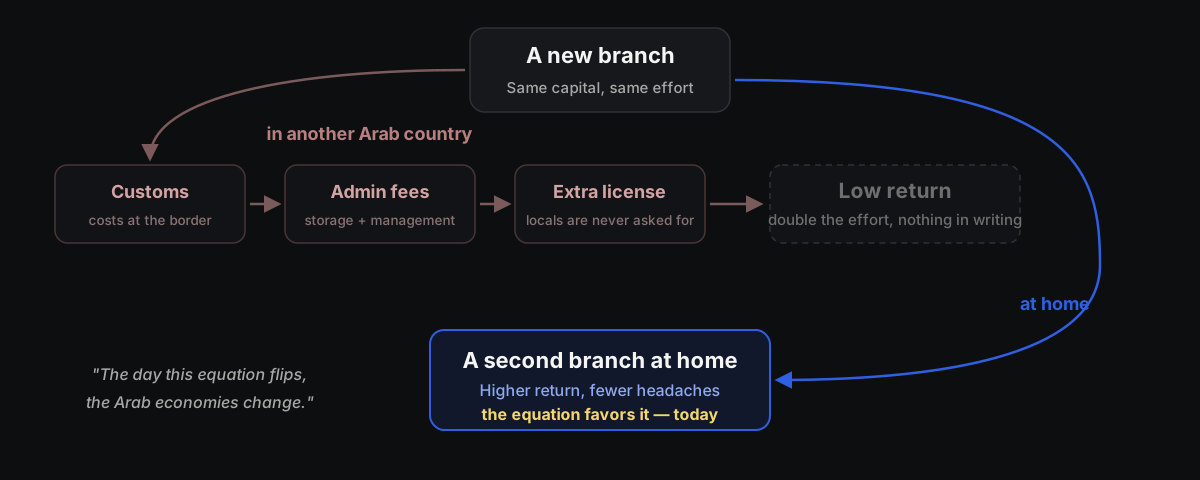
“The day this equation flips, the economy of the Arab countries changes.” That is the sentence I want you to leave this article with. The problem isn’t merchants’ intentions or people’s enthusiasm — the problem is an effort-to-return equation that, today, loses to the simplest local alternative.
The fix is a contract, not a slogan
Flipping the equation takes a real economic alliance — and a real economic alliance gets written, studied, and documented, with many conditions put on paper and enforced. Not a summit’s closing statement, but a contract a merchant can invoke at the border.
And we wouldn’t be the first to do it: economic alliances exist and work — in Europe, in Asia, in South America. On this file, we are behind.
The takeaway
If someone tells you, “Open branches across the Arab countries — it’s one market,” know that they’re reading the map of language, not the map of money. The language is one, truly. But the money speaks twenty-two regulatory dialects, each defending its own borders. Until a real economic alliance is written and enforced, your next branch’s profits — for most businesses, and small ones especially — most likely live in your own city, not across a border.
Claude’s Questions
This section is prepared by Claude. After the article was written, the AI engine I build my work with stress-tested the argument and asked what a sharp reader would ask. I haven’t answered yet — I will when I’m free, in an update to the article or in the comments. This conversation between us is part of the idea itself.
1. Big Arab companies did expand regionally and won — what do they have that you don’t? Gulf retail chains, restaurant groups, and apps operate profitably across several Arab countries today. What flips the equation for them — scale? Local partnerships? The ability to eat years of losses? And where is the size threshold below which the trap stays a trap?
Yasser will answer when he’s free — watch for an update or the comments.
2. Does a digital product escape the trap? The article is built on goods crossing borders. But software and digital services pass through no customs and no warehouses — so is the Arab digital market genuinely “one market,” or do the borders take other shapes that are waiting for it: payment gateways, licensing, digital taxes?
Yasser will answer when he’s free — watch for an update or the comments.
3. I have real demand from customers in another Arab country — what do I do on Monday? The demand exists and I won’t ignore it. Do I export through a local distributor who absorbs the border himself? Find a citizen partner? Or turn the demand down and open my second branch at home, as the equation suggests?
Yasser will answer when he’s free — watch for an update or the comments.
4. Europe didn’t start with a single currency — it started with coal and steel. The article calls for a comprehensive written alliance, but history’s most successful bloc began with just two commodities and expanded over decades. So is what’s needed really one grand contract — or one Arab good crossing one border with zero friction, first?
Yasser will answer when he’s free — watch for an update or the comments.