

A note before you read: this piece began as my own voice notes and raw ideas — Claude wrote them up, edited them, fact-checked the numbers, and added the sources. The core opinion is mine; the wording is a partnership between us. I’d rather ship the idea alive than wait until it’s perfect.
A message lands: “I have a business idea.” And I’ll be honest with you: the first thing I feel is sadness.
Not because the idea is bad — some of them are excellent. Because the message itself tells me what happens next: they’ll build the 80% of the business with real enthusiasm, then stop at the 20% that makes the sale. If they were going to do that 20%, they wouldn’t have contacted me in the first place — every piece of information is out there today for anyone who wants it. They’re not looking for information. They’re looking for a shortcut. And to this particular 20%, no shortcut exists.
The 80% anyone can build
Every business stands on basics we all know. A product — something you exchange for people’s money. Visibility — if you’re online, no eyes means no sales. An audience — people who see the offer and can actually pay. Management — a full team or one person, but no business runs without someone running it.
I can build all of these fast today — some of them I have sitting ready; I swap the product and the structure stays. And that’s exactly the point: if I can build them fast, so can everyone else. What gets built fast separates nobody.
I flipped the rule — on purpose
There isn’t a person in business who hasn’t heard of the 80/20 rule. Its origin is well documented: in the late nineteenth century, the economist Vilfredo Pareto observed that roughly 80% of Italy’s land was owned by 20% of its population, and Joseph Juran later carried the pattern into quality control and generalized it as the “vital few” — a small number of causes produce most of the results. (source)
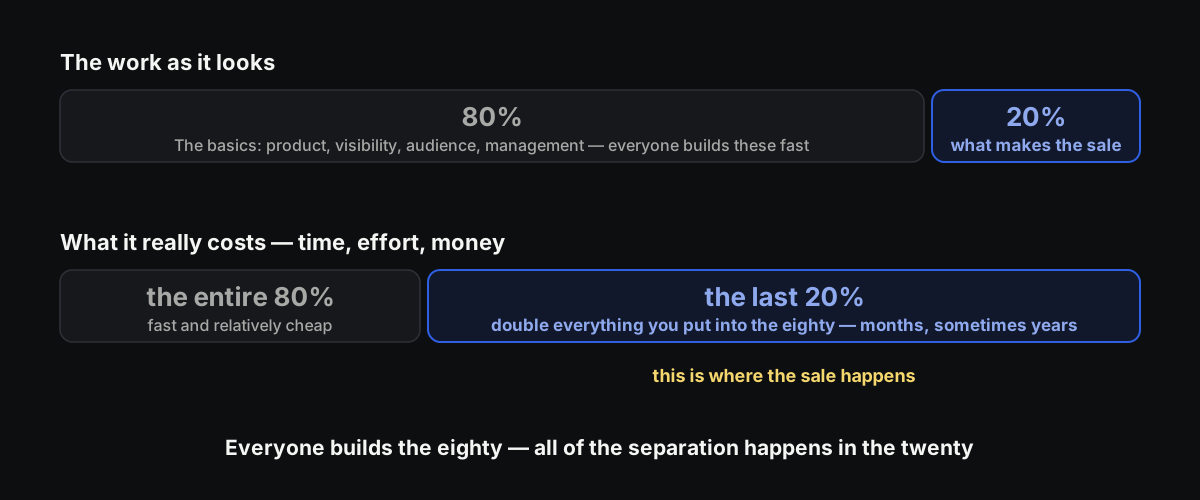
I’m talking about something else — and I know I’m flipping the rule. I’m doing it deliberately. The version I actually live while building businesses says: the last 20% of the work costs double everything you put into the first 80% — in time, effort, and money — and it alone is what makes the sale worthwhile and profitable.
And I’m not the first to notice the inversion. Software engineers got there decades ago and gave it a wry name — Tom Cargill’s ninety-ninety rule, from Bell Labs: “The first 90 percent of the code accounts for the first 90 percent of the development time. The remaining 10 percent of the code accounts for the other 90 percent of the development time.” (source) It adds up to 180% — that’s the joke, and that’s the truth.
“It’s only twenty percent?”
Some will push back: if the 80% is done, why all this anxiety about the rest? I don’t blame them — nobody believes in the weight of this 20% until it has bitten them once. The new employee, the investor, the partner — on paper it looks small to all of them: “What’s the problem? It’s only twenty percent.”
Let me be precise: I’m not talking about perfection — perfection belongs to God. I’m talking about complete enough to bring you a sale: a payment gateway that actually works, a purchase flow that doesn’t break halfway through, small details nobody notices until their absence kills the deal. These pieces have taken me months — sometimes years. And finishing a single percent of them demands double the time, effort, and money you poured into the entire eighty.
The 20% doesn’t just take your effort — it takes your life
Take something smaller than a whole business: reaching an important person. Finding their number is 80% of the task — research, contacts, messages. Actually picking up the phone and calling them is the 20%. Guess which one keeps getting postponed.
And this 20% doesn’t just cost effort; it takes your time away from your other projects and from things that matter in your life. Which is why I say this with confidence: whoever has one serious business has no time. And whoever claims to be running three successful businesses simultaneously is one of three things: born with a golden spoon, backed by people doing the work for them, or exaggerating.
The LinkedIn illusion
Which brings me to the job market. We open LinkedIn and read the experience sections: so-and-so “delivered, built, achieved.” I have one question: the computer in your hands, the app you’re scrolling — did you build those? Nobody can claim to have made anything except by standing on something else. I won’t go deep into the philosophy, but it is impossible to compare two people’s experience from their words alone — you have to know the organization.
An organization with twenty thousand employees? The work an individual does there is routine, stable, and rests on a foundation that was there before they arrived — but the reputation says “wow.” A person in a four-employee company? Their experience is gold: they taught themselves the software, they were the one who fixed the printer, they went hunting for the parking spot downstairs.
It baffles me how the job market gives someone from a famous company more than their due. I’m not generalizing — inside big companies there are people who genuinely founded and built things. But the rule I hire by and judge by is this: a successful small company you’ve never heard of? That employee is a success — because they did the 20% everyone runs from, with no infrastructure holding them up.
The takeaway
This rule is harsh; some days I’ve wished I’d never learned it. But knowing it is a relief: when the months slow down on your last 20%, you won’t think something is wrong with you — this is the real price of a sale, and nobody gets to skip paying it. Everyone builds the 80%. All of the separation happens in the 20%.
Claude’s Questions
This section is prepared by Claude. After the article was written, the AI engine I build my work with stress-tested the argument and asked what a sharp reader would ask. I haven’t answered yet — I will when I’m free, in an update to the article or in the comments. This conversation between us is part of the idea itself.
1. When is quitting at eighty the right call? If the last 20% costs double everything before it, some projects aren’t worth that price. What sign separates a 20% worth paying double for from a sunk-cost trap that drowns you for years in a project that should have died?
Yasser will answer when he’s free — watch for an update or the comments.
2. The strongest objection: the “launch early” school says the opposite. Ship-fast advocates argue that polishing the 20% before touching the market is waste — launch the 80% and let the first customer tell you which 20% deserves building at all. How do you reconcile “complete enough to bring a sale” with the risk of perfecting the wrong part?
Yasser will answer when he’s free — watch for an update or the comments.
3. I work at a giant company — what do I do on Sunday? My whole experience is the kind you described: routine, built on a ready foundation, polished by the brand. How do I build the four-person-company kind of experience — being the one who fixes the printer and teaches themselves the software — without resigning?
Yasser will answer when he’s free — watch for an update or the comments.
4. Is running from the 20% laziness… or rationality? The article assumes whoever asks for a shortcut won’t deliver. But if most projects fail, refusing to pay “double everything” before seeing proof of demand might be sound math, not escape. What does your position assume about who deserves to build in the first place?
Yasser will answer when he’s free — watch for an update or the comments.