

A note before you read: this piece began as my own voice notes and raw ideas — Claude wrote them up, edited them, fact-checked the numbers, and added the sources. The core opinion is mine; the wording is a partnership between us. I’d rather ship the idea alive than wait until it’s perfect.
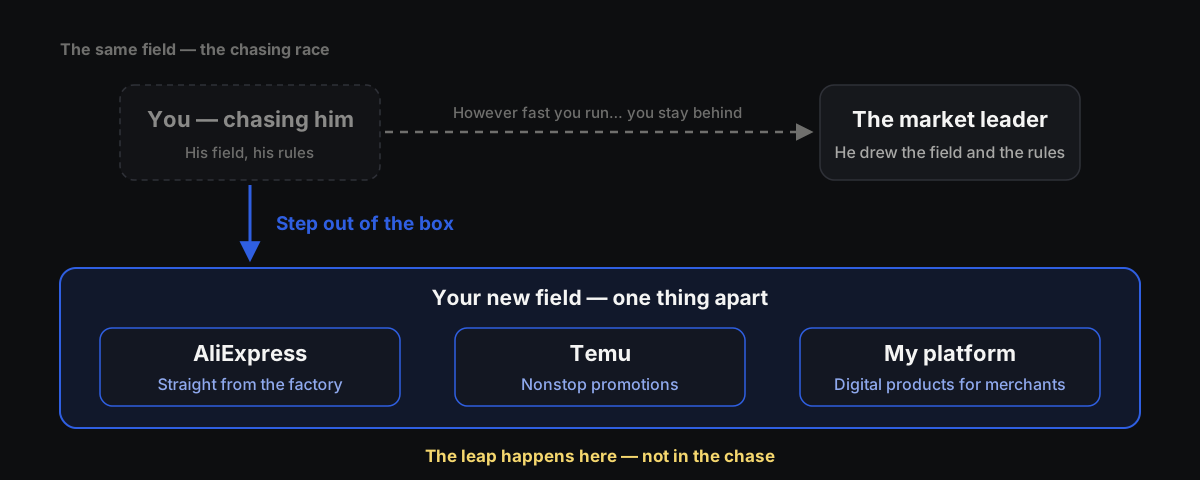
On a platform I built years ago, I stood in front of a fact that no amount of polish could fix: I couldn’t catch the market leader. No hope. I didn’t have his team, his funding, or his head start. Two roads in front of me: keep running behind him forever, or step out of the box I had put myself in.
I stepped out. I opened the platform to merchants selling digital products — something the leader didn’t offer. And the move succeeded beyond what I expected. Not necessarily a revenue success; the success was that I won a new share of the market: anyone who wanted a digital-products store thought of me before they thought of the leader. (Why I eventually shut the whole project down is another story — I told it in Vertical or Horizontal?.)
Chasing is a strategy. Leapfrogging is something else
I see the same goal hanging on the wall in a lot of companies: how do we catch the market leader? And to be fair: that’s a smart strategic move. Whoever chases learns, improves, and knows where he stands.
But chasing, by its nature, reserves you second place at best. You’re playing on his field, by his rules, and he’s the one who drew the field in the first place. What makes you pass him isn’t becoming a better copy of him — it’s differing from him in one thing his field can’t contain. Even if he’s ahead of you on many fronts, stepping out of the box can put you stages ahead of him.
And this isn’t my idea alone; it’s the core of Blue Ocean Strategy: stop fighting on the dimensions everyone has mastered — create a new dimension that makes the competition irrelevant. (source)
AliExpress didn’t wait to become Amazon
Take the biggest field in the world: Amazon. In 2010, Alibaba launched its consumer-facing arm — AliExpress — to compete with Amazon on its home turf. (source)
AliExpress didn’t say: I’ll wait until I build warehouses like Amazon’s, delivery like Amazon’s, a catalog like Amazon’s. It did one different thing: it connected you straight to the factory. One simple move made people say “AliExpress gets me the goods” — and a whole world took off from it: dropshipping and the from-China trade. Its entire model ran on direct international sourcing — the dimension Amazon’s model wasn’t built on.
Then someone ran the same play on AliExpress. Temu didn’t try to be a better AliExpress; it picked one dimension nobody had played this hard: promotions. Nonstop deals, games, coupons, giveaways — to the point that stories spread of users whose entire orders arrived free. (source) Yesterday’s out-of-the-box player had become the box — and someone stepped out of it.
The same idea works on a kitchen table
A story I tell all the time: back in the dropshipping days, everyone was selling mugs. One seller looked at an oversized cappuccino cup that happened to look like a soup bowl and said: this isn’t a mug — this is a soup bowl. He redefined the product itself and opened a new market for himself, while everyone else fought over the mug market.
And in print-on-demand — I went deep into it during the 2019–2020 boom — the companies are many and the service is nearly identical. What separates them? The product they print on. One company specialized in kitchen aprons, another did mugs only; each picked an angle that took it out of direct competition. Because if we’re all competing on t-shirts, the customer is lost — and he’ll only pick me if I give him one clear reason to buy from me specifically.
The price: your current customer won’t like the change
Here’s the point most people talking about differentiation skip: change has a price, and your current customer pays it first. A customer used to one specific thing will not be happy when you change it.
That leaves you in front of a decision you can’t postpone: either keep the current customer happy and stay in the box, or say — calmly, taking full responsibility — this change will upset one customer and bring ten more. There’s no answer that’s always right; there’s only a decision you should make consciously, instead of letting fear make it for you.
How to find your one thing
If you want to start something new right now, the recipe is simpler than you’d expect:
- Pick a niche, and name the competitor in front of you. Any niche, any competitor.
- Find one thing you’ll do differently from him. Just one — that’s the password. You don’t need a list of twenty features; you need one dimension he isn’t playing on.
- Test it before you bet on it. A beautiful hypothesis in your head is not evidence.
- And look beyond your borders. You’ll often find a competitor in another country already offering that difference — study his method and what he took from the market. That’s a free feasibility study someone else ran for you.
The takeaway
Chase the market leader if you like — the chase is a school. But remember its ceiling is second place. AliExpress didn’t wait to become Amazon, Temu didn’t wait to become AliExpress, and I didn’t wait to catch my competitor. One thing apart, tested seriously — that’s all you need to leap over a competitor who beats you at everything else.
Claude’s Questions
This section is prepared by Claude. After the article was written, the AI engine I build my work with stress-tested the argument and asked what a sharp reader would ask. I haven’t answered yet — I will when I’m free, in an update to the article or in the comments. This conversation between us is part of the idea itself.
1. Isn’t this survivorship bias? For every AliExpress there are a thousand “different things” that died quietly — difference alone guarantees nothing. What makes a particular difference a leap rather than a gimmick? And how do you tell the real edge from the stunt before the market delivers its verdict?
Yasser will answer when he’s free — watch for an update or the comments.
2. What if the leader copies your one thing in a quarter? The bigger competitor has the team and the money to clone any visible feature. When does the “one thing” stop being protection — and is a copyable difference a difference at all?
Yasser will answer when he’s free — watch for an update or the comments.
3. I have a running business and existing customers — what do I do Monday morning? The article says: test. But testing on a live business touches real customers who pay today. How do I try my one thing without betting the whole company on it?
Yasser will answer when he’s free — watch for an update or the comments.
4. The article assumes customers reward the different — but people buy the familiar. Most of us return to what we know even when something better exists. Does difference win despite the force of habit, or only when it solves a pain the familiar never solved?
Yasser will answer when he’s free — watch for an update or the comments.