A note before you read: this piece began as my own voice notes and raw ideas — Claude wrote them up, edited them, fact-checked the numbers, and added the sources. The core opinion is mine; the wording is a partnership between us. I’d rather ship the idea alive than wait until it’s perfect.
Imagine you’ve just opened a gym. The floor is ready, the machines gleam, the door is open. But why would anyone leave home to walk on a treadmill they could just buy and put in their bedroom? Today the answer is obvious: the gym is cheaper, faster, no maintenance, a change of scenery, trainers, people you know. But those reasons didn’t grow in the customer’s head on their own. Someone planted them there, over years.
That’s the thing most founders miss: a customer doesn’t buy in a moment. They move through four stages before they pay. Confuse the stages, or think you can skip one, and you’ll burn your money in the wrong place.
None of this is new. The oldest model in marketing — AIDA, laid out by the American advertising pioneer Elias St. Elmo Lewis at the end of the 19th century — maps the buyer’s journey in four steps: attention, then interest, then desire, then action. What I’m describing here is the working shape of that sequence, seen from the side of someone building the product, not teaching it.
Stage 1: They know you exist
Before anything else, people have to know you’re out there — that you’re a name, a brand, a thing that exists. Nothing happens before this moment. If someone knows you by name, you’ve cleared stage one. It’s the cheapest stage and the most obvious, which is exactly why so many people mistake it for the whole game. It isn’t.
Stage 2: They know they need you
Knowing your name is one thing. Knowing why they need you is something else entirely. This is where the customer realizes the problem you solve already lives in their life — that they need your category in the first place.
Back to the gym: today everyone knows why they go, because decades of marketing taught them. But imagine you opened the first gym in the world. Your fight wouldn’t be getting people to know your name — it’d be convincing them that leaving the house to exercise is even a sensible idea. This stage is the hardest and the most expensive, and it’s where most new ideas stall: they don’t die because they’re bad, they die because they spend all their fuel convincing people they need the thing at all.
Stage 3: Comparison
Once a customer knows they need your category, they start to compare. They line you up next to your competitors and the alternatives, and they weigh you. Here’s the crux: most companies enter the market at exactly this stage — because the category is known, the need is settled, and the customer is genuinely shopping. All these companies need is for their brand to stand out inside the comparison, and they walk straight into the mind of a customer who already intends to buy and is just deciding between options. Whoever wins here wins because they entered the buyer’s head at the right moment.
And this is precisely why a new idea can’t start here. You’re new, you’re a stranger, there’s nothing to compare you against yet. So how do you position yourself in a comparison nobody started? A new idea doesn’t enter through the comparison door — it enters through awareness. That difference is the line between a venture that needs enormous capital and one that grows fast.
Stage 4: Trust
That leaves the point where the decision actually gets made: trust. Which customers have you served? What did they say about you? Who used you? It used to be that the answer came from your inner circle — a friend or a relative we’d ask, and their word settled it.
But this stage has changed, radically. People now ask AI before they ask their friends. In a July 2025 survey by Omnisend of more than 1,200 U.S. consumers, roughly 59% said they use AI tools when shopping, and 65% of those preferred ChatGPT. The source of trust is moving from friends to the machine — and that makes buying far easier than it used to be.
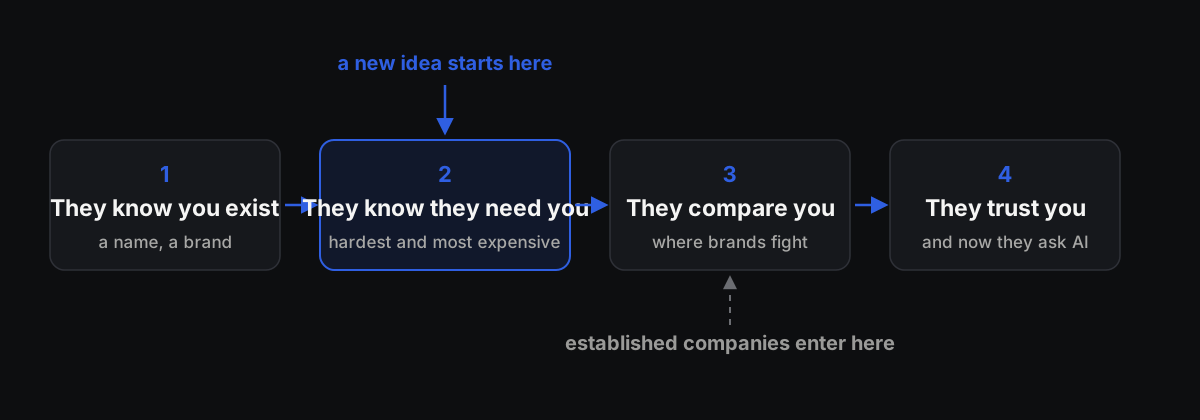
The map
Compress the four stages into one line, and you have a compass for every marketing decision:
- Know me — you know I exist.
- Know you need me — you know my problem answers a real need in your life.
- Compare me — you line me up against the alternatives and weigh them.
- Trust me — you settle the decision on who came before you and what they said.
A company standing on a known category enters at stage three and fights in the comparison. A new idea has no choice but to start at stage two and fund the awareness fight first. Knowing which door you enter is half the game. The other half — how to make AI your first ally at the trust stage — is a longer conversation. I’ll give it its own piece.
Claude’s Questions
This section is Claude’s. After the piece was written, the AI I build my work with stress-tested the argument and asked what a sharp reader would. I haven’t answered yet — I will when I’m free, in an update to this post or in the comments. That back-and-forth between us is part of the point.
A brand-new category has nothing to compare against — so which stage does a genuinely new product enter at, if not “comparison”?
Yasser will answer when he’s free — watch for an update or the comments.
Stage 4 (trust) is shifting from friends to AI. Concretely, what does a founder do to become “the answer AI gives”?
Yasser will answer when he’s free — watch for an update or the comments.
“Awareness you exist” and “awareness you’re needed” are both awareness — what breaks if we collapse them into one stage?
Yasser will answer when he’s free — watch for an update or the comments.