

A note before you read: this piece began as my own voice notes and raw ideas — Claude wrote them up, edited them, fact-checked the numbers, and added the sources. The core opinion is mine; the wording is a partnership between us. I’d rather ship the idea alive than wait until it’s perfect.
I built forty projects. I succeeded at them, thank God — and then I left every one.
That isn’t a boast, and it isn’t a number I throw around lightly. It’s a weight. Every time I look at it, I can’t decide how to read it: is it a record of achievement, or evidence that something in me is broken? For years I’ve circled the same question: is this a disease, or a blessing?
I never once left a project because it failed. That’s not the problem. The problem is that I go in, I win, and then I hit the ceiling of what it can teach me — and I stop. The money matters to me far less than the learning does. The day a project stops teaching me something new, I feel it has given me everything it has, and I leave to look for a higher ceiling.
So I came to see the leaving as the symptom. The real question sits underneath it: is that ceiling of knowledge, on its own, enough to make a person happy? Because this disease — if it is one — isn’t a curse or a gift in itself. It’s one of the reasons I keep searching for happiness in the first place. So what am I actually searching for when I walk away?
The five conditions
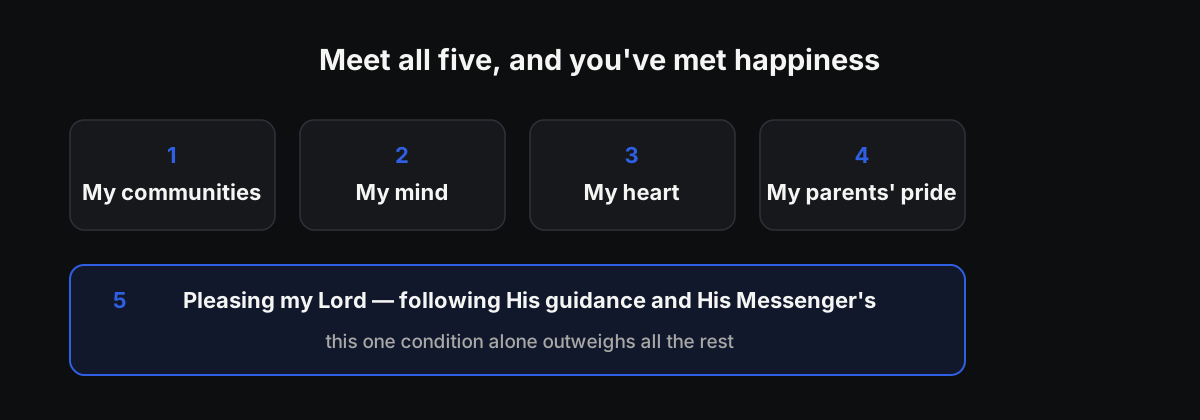
In every talk and every interview, I’ve named five conditions. Meet them, and you’ve met happiness. They’re my measure — and they’re the reason I leave projects, even the successful ones. When one of them goes missing, I know it’s time to go.
One — that I serve my communities. The Saudi community, the Arab community, the community of commerce, the community of technology. I want to watch these communities grow, and I want to hand them something that helps. Start me on a project that doesn’t help them, and I’ll grow bored and walk — and I won’t be happy.
Two — that I satisfy my mind. My mind has to be content with what it learns each day, content that its hours are being spent on something worthy. If my mind isn’t satisfied, I won’t be happy.
Three — that I satisfy my heart. I want to be at peace with what I do. I don’t want to do something for money, or just to learn, or to be known. I want to do it because I’ve given a sadaqah — to my community, to myself, to my kids, to the people around me. Something I enjoy, and something my heart can rest on.
Four — that I make my mother and father proud. I want something they can point to. I want them to say their son gave something. And yes, that helps me.
Five — and this one outweighs them all — that I please my Lord. That I follow His guidance and the guidance of His Messenger ﷺ in every step I take. This one condition alone tips the scale against the rest.
When leaving becomes a flaw
Here’s where my answer to the opening question comes clear: disease, or blessing?
The leaving itself isn’t the disease. The disease is in misreading it. When I leave a project that no longer satisfies my mind, my heart, or my communities, I’m not running — I’m choosing what deserves my time. The five conditions are the compass, and walking away isn’t weakness when the absence is real.
But leaving becomes a flaw in one exact moment: when I leave before I’ve given the sadaqah — when the driver is boredom, not exhaustion; chasing the new, not finishing the worthy. The line is fine but it’s decisive. Leaving because the well ran dry is one thing. Leaving because you’re tired of carrying the bucket is another. The first is a duty honored; the second is an escape. And the test is simple: did I satisfy the five conditions before I left — or did I leave to escape them?
To you, reading this
If you find work where all five come true, do not let it go. And if you haven’t found it yet, keep searching — God does not disappoint the one who seeks.
How do you get there? Startups reach for these very things. They chase relationships, reputation, trust — so they cover three or four of the five, right up until their thinking hardens into the logic of capitalism. The rest comes with time, God willing. Don’t start something from zero for no reason, because these five aren’t new and they aren’t a secret. Every sharp, awake person is looking for them; they’re well known. Sit with yourself, write your thinking down, take it apart — and you’ll arrive at them on your own.
One exercise: ask “why”
The best exercise I know is this: ask yourself why. Whatever answer you give yourself, ask it — why? Then ask again. And again. You have to reach the root of the idea, its foundation, its source.
This exercise isn’t mine. In the Toyota Production System, Sakichi Toyoda built a method they call the “Five Whys”: when a machine breaks, you don’t patch the surface fault — you ask “why” five times in a row until you reach the root cause, not the symptom. The same principle applies to a person with unnerving precision. The symptom you see on the surface of your life is not the cause, and the cause won’t show itself until you’ve dug for it.
The first time I ran this test on myself, it brought tears to my eyes. I saw that the reason I’d been building on would fail in the end, and my thinking turned 180 degrees. Ask yourself why, be honest with yourself always, and you’ll see a staggering change. You’ll start noticing, in the people around you, that you’re thinking more clearly than they are — as long as you keep asking, and stay curious to the furthest degree about anything that happens.
And research the thing; don’t rush to pronounce on it. Learn — but you don’t have to become a perfectionist. Learn to the depth the information actually requires; don’t sail out further than you need and lose your time. The new is coming, and you’re already on your way to it.
I built forty projects and I left them. And after all that asking, I found the answer: I was never leaving the projects — I was searching for the five conditions. The leaving is a blessing as long as it stays a search. It only becomes a disease the day it turns into a flight.
Claude’s Questions
This section is Claude’s. After the piece was written, the AI I build my work with stress-tested the argument and asked what a sharp reader would. I haven’t answered yet — I will when I’m free, in an update to this post or in the comments. That back-and-forth between us is part of the point.
1. You open by asking whether leaving forty projects is a “disease or a blessing” — and you answer it in the body, but let’s be blunter: which is it, deep down, and when exactly does the leaving become a real flaw in you, not in someone else?
Yasser will answer when he’s free — watch for an update or the comments.
2. You say condition five — pleasing God — “outweighs them all.” So if a project satisfied only that one and none of the other four, would you stay? Or does condition five only count when it’s stacked with the rest?
Yasser will answer when he’s free — watch for an update or the comments.
3. You say startups cover three or four of the five before the logic of capitalism takes over. Which condition dies first — and can a founder design the company to defend against that death?
Yasser will answer when he’s free — watch for an update or the comments.