
A note before you read: this piece began as my own voice notes and raw ideas — Claude wrote them up, edited them, fact-checked the numbers, and added the sources. The core opinion is mine; the wording is a partnership between us. I’d rather ship the idea alive than wait until it’s perfect.
Early in my journey, one question kept nagging at me: how do I sell something with a high price and almost no cost to me?
My first answer was simple and exhausting: build the customer a complete business from scratch. Products, website, everything. It didn’t cost me much money — but it ate my time alive. One project took a month, two months, sometimes a full six. The price was decent — five to fifteen thousand riyals — but the math didn’t hold. I couldn’t hand over six months of my life for that.
Still, those early builds taught me something valuable: I learned the market. And I knew exactly what I was doing during those six months.
So I asked myself: if I already know the market, why keep doing the work by hand? Why not build them an automated system that does exactly what I was doing?
I built the system. Priced it roughly the same. Launched it.
A brilliant success, and one problem
The system was a massive hit. It had exactly one problem: nobody stayed.
The customer would buy once, and that was it. Then the messages started: “Give me my money back.” “You scammed me.” The same service that used to wow them when I built it by hand — a complete, end-to-end business — was now a fraud in their eyes.
I sat with the question: why don’t they stay?
I thought the problem was price. I dropped it. Nothing changed. If anything, the customers who paid more complained less — which is a funny truth about selling: whether you sell something for one riyal or a hundred thousand, the complaints are the same, and maybe fewer at a hundred thousand, because the person paying a lot studies the decision before he pays. The one who pays little buys without thinking, then comes back to bother you.
I thought the problem was understanding. Maybe they didn’t get the system because it was automated, with no human beside them. I added training, instructions, made it easy to use. Same result. Worse, actually: the more the customer learned, the more questions he had, and new needs surfaced that the system was never built to handle.
I thought the problem was clarity. I once watched a webinar from a big global hosting company. They’d cut their support load by breaking everything into packages and price tables — every feature with a known price. So I did the same: a starter plan, then a second, then a third. It half-worked, but the questions kept coming on the pricier tiers, to the point where I had to build an entire team just to service this one problem.
Every logical explanation I tried — every one of them failed. Because I was answering the wrong question.
The real job
Here it’s worth pausing on Clayton Christensen, the Harvard professor, and his famous milkshake story.
A restaurant chain wanted to sell more milkshakes, so they improved the product every way they could think of — to no effect. Then Christensen’s team noticed something strange: nearly half of sales happened before 8:30 a.m., to customers buying a milkshake alone, in their cars, then driving off. So they asked a different question: “What job did you hire this milkshake to do?”
The answer turned out to be one and the same: a long, boring commute, and an idle hand that wanted something to do. They weren’t buying a drink; they were hiring a companion for the road. The heart of Christensen’s idea — which became known as Jobs-to-be-Done — is that the customer doesn’t buy the product; he hires it to get a job done in his life. And people, most of the time, don’t want what they literally ask for.
Henry Ford is often quoted as saying: “If I’d asked people what they wanted, they’d have said a faster horse.” The line is almost certainly apocryphal — Ford never said it — but the idea it carries is true, and it’s exactly what hit me when I tried the last fix.
The kitchen, not the dish
I tried that last fix without believing, even one percent, that it would work. Because the entire system — start to finish — was built on a single promise: that you’d have a ready-made business in the shortest possible time. A proven, tested business. All you have to do is run it.
So what was the problem?
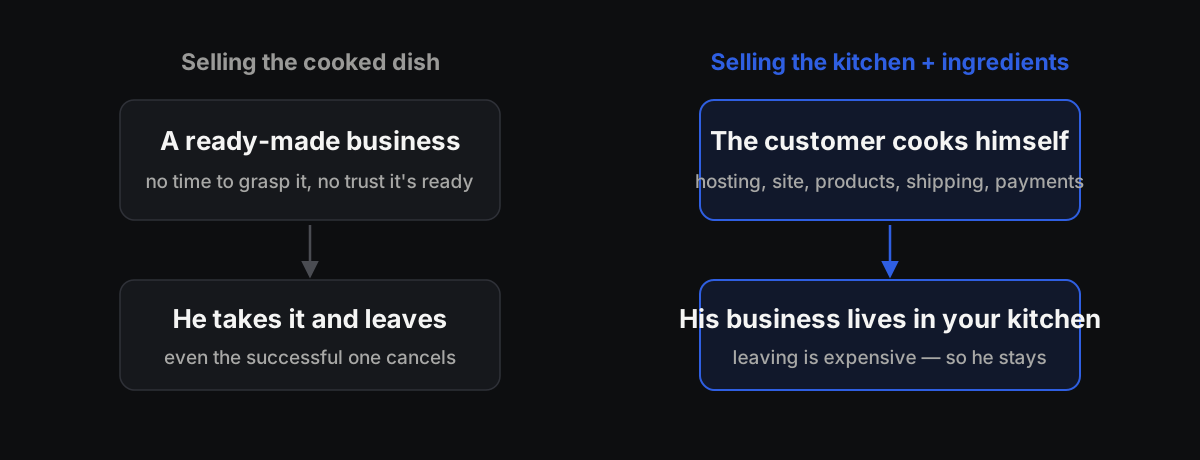
The problem was that he didn’t want to run a ready-made business. He wanted to build the business himself.
That day I told the customer: you don’t want the dish cooked, you want the ingredients. Fine — why am I cooking for you? Pay the chef to prep your ingredients, then do the cooking yourself.
So I gave them all the ingredients, and taught them how to use them. The customer now spent his time cooking, not receiving a finished dish. I put his hand right inside my pot — and to get it out, he’d have to keep paying a subscription, or stay and keep cooking inside my kitchen.
That’s when the system worked — massively, for the first time.
Because when you think about it hard enough: the customer never wanted the ready-made thing at all. He didn’t have the time to understand it, or the trust to believe it was actually ready. What he had was an idea, and a desire to build it and try it with his own hands. All he was missing were the components: hosting, a website, products, delivery, shipping, payments. Hand him those, and let him build his business his own way.
This is what Chris Dixon means by “come for the tool, stay for the network.” The tool alone is what pulls the customer in the first time; what keeps him is whatever gets built inside your tool and can’t be carried out of it. The moment I turned my product from a dish he takes and leaves, into a kitchen he builds in, leaving got expensive — because his business now lived inside my pot.
The strange part
And here’s a paradox I doubt anyone would believe if I told it, but it’s something I lived:
Back when I built everything for customers by hand, their businesses profited and succeeded. So what does the successful one do? He cancels his subscription — he got what he came for. Meanwhile the one who built his business himself, many of them sell nothing and profit nothing — and yet they keep paying the subscription.
The successful one leaves. The struggling one stays.
A strange paradox, I know. But it’s exactly what confirms the whole idea: the job they hired my product to do was never “a profitable company.” It was the experience of building it themselves. And the one who’s building stays in the kitchen — whether the dish is done or not.
The takeaway
Don’t listen literally to what your customer asks for. Ask what job he’s hiring you to do.
He might ask for the cooked dish, when what he really wants is the kitchen. Give him the ingredients and the kitchen, not the finished plate. And make the kitchen yours — because that, alone, is what keeps him.
Claude’s Questions
This section is Claude’s. After the piece was written, the AI I build my work with stress-tested the argument and asked what a sharp reader would. I haven’t answered yet — I will when I’m free, in an update to this post or in the comments. That back-and-forth between us is part of the point.
Your own data says self-builders succeed then cancel, while ready-made buyers fail but keep paying — so does “give them the kitchen” secretly optimize for churn? How do you reconcile retention with customer success?
Yasser will answer when he’s free — watch for an update or the comments.
Where’s the line between “ingredients” and “dish” — too little is DIY hell, too much and they don’t need you?
Yasser will answer when he’s free — watch for an update or the comments.
You say people want the experience of building, not the result — is that everyone, or a specific buyer? Who genuinely wants the finished dish?
Yasser will answer when he’s free — watch for an update or the comments.