
A note before you read: this piece began as my own voice notes and raw ideas — Claude wrote them up, edited them, fact-checked the numbers, and added the sources. The core opinion is mine; the wording is a partnership between us. I’d rather ship the idea alive than wait until it’s perfect.
One million Saudi riyals. That’s what it cost me to learn the difference between a vertical business and a horizontal one. I didn’t read it in a book or hear it in a lecture. I paid it in cash, out of my own pocket, over the life of a business I built and then shut down with my own hands.
Let me start with the definition, because everything that follows rests on it.
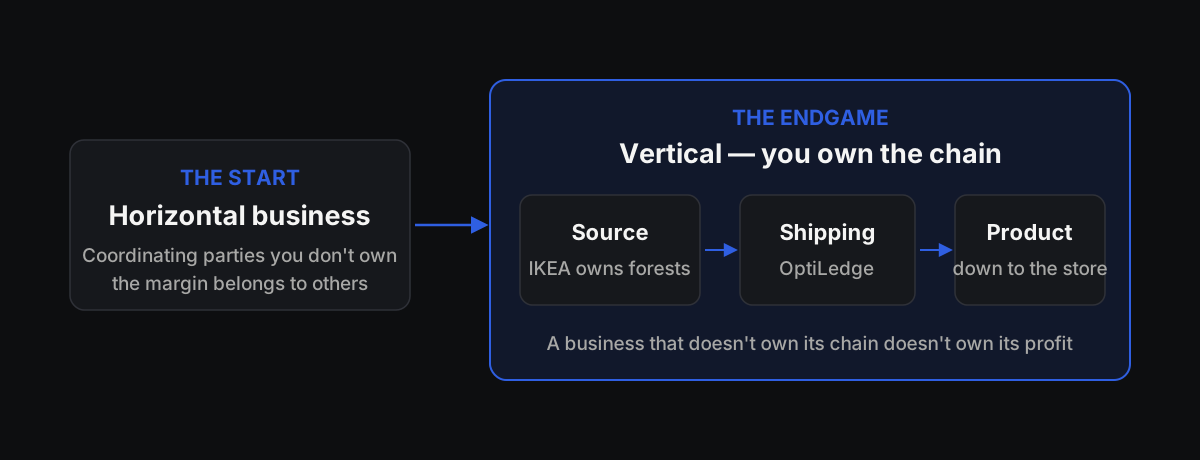
A horizontal business spreads out sideways: many departments, many services, many sources — and most of them come from outside. External companies, external costs, external complexity. You sit in the middle coordinating between parties you own none of.
A vertical business is the exact opposite: every link in the chain is under your control. From the raw material to the product to the delivery. This is what strategy people call vertical integration — your company owning its supply chain instead of renting it. (definition)
And the difference between the two isn’t academic. The difference is who owns the profit.
IKEA: how a company moves from horizontal to vertical
For my master’s thesis, I studied IKEA. IKEA wasn’t born vertical — it started horizontal, and then spent decades moving toward vertical, one link at a time. Today it’s the clearest living example of what I’m describing.
Look at what it did.
It owns the forests. When timber prices spike and supply gets unpredictable, IKEA doesn’t stay hostage to the market. It bought the forests itself — it now owns hundreds of thousands of hectares of forestland across several countries, growing and cutting the wood for its own furniture. (source) That’s the first link in the chain, and IKEA didn’t leave it to anyone else.
It reinvented shipping. A traditional wooden pallet weighs around 33 pounds and eats a lot of space. So IKEA invented a replacement it calls OptiLedge — small plastic ledges clipped onto the corners of the carton, each one weighing under two pounds. One truckload of them equals twenty-three truckloads of wooden pallets. (source) In 2012 IKEA phased out wooden pallets entirely, saving enormous cost in fuel, labor, and container space across its international shipping.
That’s the peak of the vertical definition: control every point, and cost and quality improve together — because there’s no one standing between you and your product taking a cut.
But that doesn’t mean one is always better
I walked into the world of marketplace platforms with everything I had. I didn’t tiptoe in — I went up against the biggest players in the space, and I genuinely won market share.
Then I shut it down.
People ask me all the time: you’d won your share — why kill it? And the answer isn’t that the business failed. It didn’t. The answer is the profit margin.
A platform is, by its nature, a horizontal business. You’re a middleman wiring together services other companies own: a payment gateway here, shipping there, marketing from a third. And the margin on being the middleman is tiny. The real profit lives inside the supporting companies themselves — the ones you don’t own.
So for the business to actually be profitable, you’d have to build those external companies in-house — which means moving from horizontal to vertical. And here’s the trap: the setup cost is enormous, the maintenance cost is enormous, and every one of those services needs its own separate marketing, education, and advertising — because, unlike IKEA where you walk into one store and find everything, these are disconnected services, each speaking to a different need.
Here’s where any sharp reader raises the obvious question: if you’d won market share, why not raise money and build the vertical layer instead of shutting down? Fair question, and I’ll leave it on the table openly — my full answer is in the Claude’s Questions section below. But the conclusion I walked away with is simple: I didn’t want to build a business that only survives on a continuous drip of investment. I wanted a business that owns its chain.
Shelf life
Here’s an opinion of mine — I know plenty of people will disagree, so I’ll say it plainly as my opinion:
Some people say software and tech services (SaaS) have no shelf life. I think the opposite is true — in my view they have the shortest shelf life of all. The setup cost is high, the maintenance cost is high and never-ending, and the horizontal income is thin. A business with that equation doesn’t last long without investment propping it up — unless you take it vertical and own the source of your profit yourself.
The takeaway
Think about your own project: is it horizontal or vertical?
Horizontal is right for beginnings — it gets you to market fast and cheap. But your endgame has to be vertical, because a business that doesn’t own its chain doesn’t own its profit; it stays hostage to a margin someone else is carving out.
And the examples are all around you.
(In the coming articles I’ll tell you about a fully vertical business — at almost no cost, with no need for investors. God willing.)
Claude’s Questions
This section is Claude’s. After the piece was written, the AI I build my work with stress-tested the argument and asked what a sharp reader would. I haven’t answered yet — I will when I’m free, in an update to this post or in the comments. That back-and-forth between us is part of the point.
1. You shut the platform down “not out of failure” but over margins — a skeptic asks: if you’d won share, why quit instead of raising money to build the vertical? What was the real trigger?
Yasser will answer when he’s free — watch for an update or the comments.
2. IKEA went vertical when it was already a giant. For a small company, buying your own “forests” too early is a common way to die. What’s the signal that it’s time to pull a link of the chain in-house — and which link comes first?
Yasser will answer when he’s free — watch for an update or the comments.
3. You say the end goal “must” be vertical — but Vercel (from the 5% piece) wins by staying horizontal on top of AWS. When is vertical the wrong goal?
Yasser will answer when he’s free — watch for an update or the comments.