

A note before you read: this piece began as my own voice notes and raw ideas — Claude wrote them up, edited them, fact-checked the numbers, and added the sources. The core opinion is mine; the wording is a partnership between us. I’d rather ship the idea alive than wait until it’s perfect.
I once heard Jack Ma, Alibaba’s founder, lay out the ideal life timeline: before 30, follow a good boss at a small company and learn; from 30 to 40, work for yourself if you want — you can still afford to fail; from 40 to 50, do only what you’re good at; from 50 to 60, develop and train young people; past 60, be with your grandchildren. (CNBC)
A beautiful schedule. But I have a rule: nothing gets taken as absolute except revealed scripture — the Qur’an and the Hadith. Everything else, we take from it and build on it. So let’s build.
The problem: what if you missed the schedule?
The timeline assumes you started on time. So what about the person who wakes up at forty with nothing to focus on? Who lost the entire “try and fail” decade?
That person doesn’t need a new plan. He needs double speed. You know the 2x button on YouTube — press it and the video runs at twice the speed? The real question isn’t “what’s the right plan for my age?” The question is: how do you press the 2x button on your life itself?
I’m not theorizing here. I’m going to hand you the trick I used myself, and it worked: teach to learn.
Why teaching, specifically?
Everyone tells you: “Learned something? Apply it.” Correct advice, and incomplete — because nobody tells you how to apply it. I have a practical answer: go teach what you learned to someone else.
The moment you decide to teach someone, everything in your head changes. You refuse to embarrass yourself, and you refuse to teach them something wrong — so you’re forced to ask: where does this knowledge begin and where does it end? Where are the real edges of my understanding? Teaching forces you into the depth that studying for yourself always let you dodge.
And this isn’t just my opinion — science proved it and gave it a name: the protégé effect. In a 2014 study published in Memory & Cognition, merely telling learners they would teach the material to others made them recall it better and organize it more coherently than learners told they’d be tested on it. (Nestojko et al., 2014) And Fiorella & Mayer (2013) found that people who actually taught the material retained their understanding longer than those who only expected to teach. (source) The famous Feynman technique — “explain it simply and you’ll discover what you don’t understand” — is the popular child of this same idea.
And remarkably, the idea lives in my own tradition, centuries before the studies: the zakat of knowledge is teaching it. Knowledge you never give out shrinks; knowledge you teach grows.
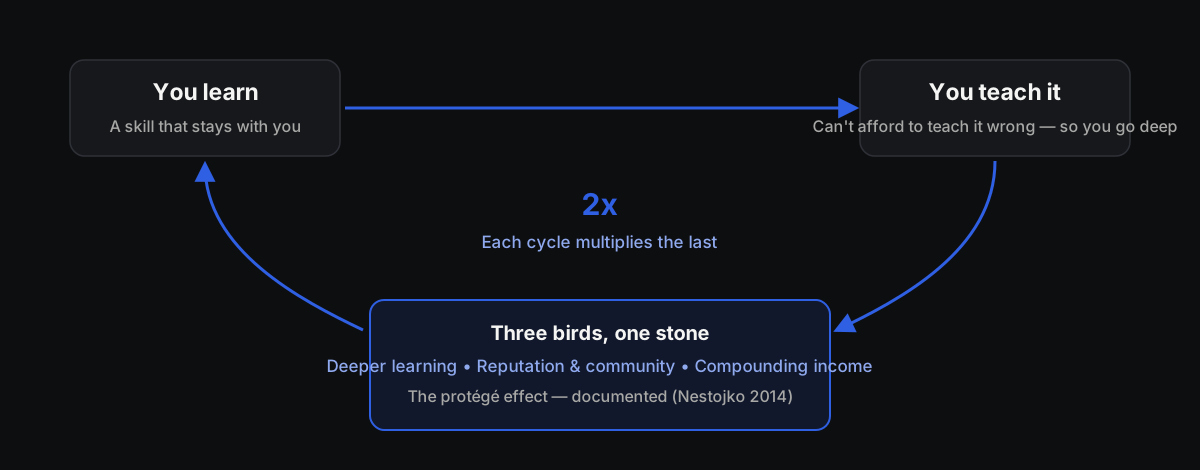
Two birds with one stone… make it three
The 2x button doesn’t work one way. You can speed up your life by hitting multiple targets with one action, and you can speed it up by deleting wasted time. Teaching does both at once:
- You learn deeper and faster — because you can’t afford to teach people wrong.
- You build reputation and community — everyone you teach now knows you and trusts you.
- You open an income stream that compounds — if you put your teaching somewhere that accumulates.
Three birds, one stone. But all of it needs something first: will. Getting out of bed to teach strangers, or to hit two targets with one action, is not normal behavior. It’s outside the ordinary — and the extraordinary needs fuel.
The fuel of will
The engines of human will are well known: anger, money, revenge. And notice how tangled they are — you’ll rarely find someone who wants money for its own sake; usually he wants it because he’s angry at his life, because he wants revenge on an existence that’s suffocating him. Your fuel doesn’t have to be noble to work. It just has to be yours, and it has to be running.
Mine was revenge on wasted time.
My story: three years worth ten master’s degrees
I studied in Saudi Arabia and I wasn’t serious — I’ll say it honestly. Then I spent close to eight years studying in the US, and I pushed hard there on one assumption: I’d come home and land the job I was aiming for. I came home… and didn’t. My chest tightened. Seven or eight years of my life, gone, and I was standing in the same place.
So I said: I’ll take revenge on those years. And the only revenge that made sense was to build something that stays with me instead of evaporating. I sat with it: what actually stays? Skills. Fine — what’s the fastest skill I could build that kills two birds with one stone? The skill of teaching.
But teaching needs material. I tried teaching English, or studying-in-America guidance — and found zero passion in me for any of it. So I asked the question that changed everything: why not hit three birds with one stone? Build my own e-commerce business, teach people how to build it while I built it, and tell the whole story on YouTube. I’d learn the skill faster because I couldn’t afford to teach people wrong, and I’d put the teaching somewhere that grows — returning reputation, community, and income.
That’s what I did, from late 2018 to around 2021 or 2022 — roughly three years. I built more than one project in order to learn them and in order to teach them, and I went deep to a degree I never would have otherwise, because the alternative was failing in front of the people watching me. I ended up with real income, and with a self-confidence that came from finally building something that stayed — something I still benefit from today.
I’ll say it plainly: those three years were worth ten master’s degrees to me.
Then I stopped. And stopping was a big mistake — I own that here. But the trick itself never stopped working.
You’re inside the trick right now
Look around: the article you’re reading is the live application of the same move. I’m teaching you what I’m learning, building a new community I’ll be part of, and opening the door to future returns — helping companies and individuals who want my services and consulting. Three birds, one stone, again.
This is my focus now, the one that should carry me — God willing — to retirement at fifty. So if Jack Ma’s schedule has already passed you by, like it passed me: don’t sit there counting the lost years. Find your fuel, then press the button: teach what you’re learning. Life at 2x starts there.
Claude’s Questions
This section is prepared by Claude. After the article was written, the AI engine I build my work with stress-tested the argument and asked what a sharp reader would ask. I haven’t answered yet — I will when I’m free, in an update to the article or in the comments. This conversation between us is part of the idea itself.
1. When does “teach to learn” turn against you? Teach too early and you spread errors with confidence. How much do you need to know before you’ve earned the right to teach? And where is the line between a learner sharing the road and a pretender selling an illusion?
Yasser will answer when he’s free — watch for an update or the comments.
2. “Those who can’t do, teach” — how do you answer? The internet is full of people teaching commerce instead of doing it, their income coming from the teaching rather than the thing taught. What exactly makes your loop different from that model?
Yasser will answer when he’s free — watch for an update or the comments.
3. I’m forty with a full-time job — what’s the smallest version of the three birds I can start this month? The story in this article began with full-time freedom and YouTube. What version survives on two hours a day?
Yasser will answer when he’s free — watch for an update or the comments.
4. What happens to the engine when the revenge is complete? The fuel behind those three years was getting even with lost time. But revenge burns out the moment you feel you’ve made it back. What replaces it — and does the loop still run on calmer fuel?
Yasser will answer when he’s free — watch for an update or the comments.