A note before you read: this piece began as my own voice notes and raw ideas — Claude wrote them up, edited them, fact-checked the numbers, and added the sources. The core opinion is mine; the wording is a partnership between us. I’d rather ship the idea alive than wait until it’s perfect.
🎁 There’s a gift at the end of this article: a one-page checklist — “Find Your 5%”.
Last week I tested two code-review tools. The first was a monster — feed it my CI config, wire up the auth, point it at my domains, and it would tear through my code with real depth. The second did one thing: it read my pull requests straight off GitHub and told me what was broken. That’s it.
I paid for the second one. It costs more, the dashboard is worse, it does a fraction of what the first one does. I didn’t care. It solved the one thing I actually came for.
Most founders read that backwards. You think a customer leaves because your product was missing most of what he needed. He isn’t. The company he was with covered 90% — 95% — of everything. He left over the last 5%. The one thing nobody handled.
And here’s the trap that eats new founders: that 5% isn’t a “missing feature.” For the person who walks, the 5% is the job. It’s the reason he showed up. The other 95% was never the point — it was scenery. Nice if it’s there, forgotten if it’s not. So the market for a 5% is smaller. But it’s specific. And specific is where you win.
Take the giants — Cloudflare, AWS, Google, Microsoft. They give a developer 90% of what he needs. There’s a 5% they never bothered with: the deploy should be one button, not a weekend. Vercel and Netlify took that 5% and nothing else.
The obvious objection: if Vercel only does the 5%, why would anyone leave AWS for it? They wouldn’t — and that’s the point. Vercel doesn’t ask you to leave AWS. It sits on top of it. The infrastructure underneath is a cost line, not the fight. What Vercel owns — the deploy, the developer’s ten seconds of joy — it owns 100%. An analyst put it plainly: Vercel and Netlify turned the cloud giants’ infrastructure into a commodity.
That’s the move. Pick one slice and go for the neck. Go so deep on that one thing you become the best on earth at it. You want domains? Connecting, buying, DNS, all of it — until you are the 90% of the domain world. And the moment you are, you’ve left a fresh 5% for the next person.
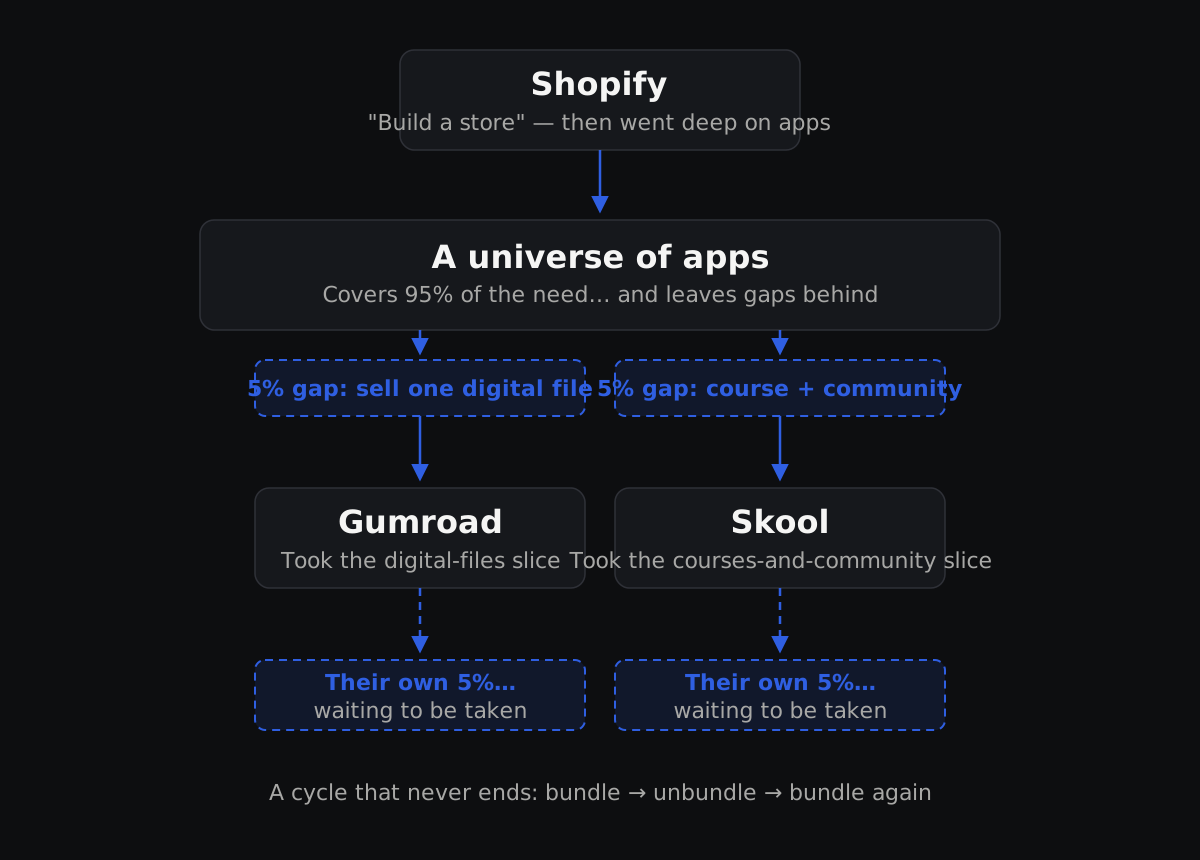
Watch it happen. Shopify started as “build a store.” Then it went deep on apps until it had a universe of them. But it left a slice behind — people who just wanted to sell a digital file. Gumroad appeared. It left another — people who wanted to sell a course and a community. Skool appeared. Go look at Gumroad and Skool today and you’ll find their 5% gaps, waiting.
This is the oldest law in business, and a Netscape CEO put it in one line thirty years ago: there are only two ways to make money — bundling and unbundling. The bundle breaks into slices. The winning slices bundle back into a new giant. That giant breaks again.
It never ends. That’s not a warning — it’s the opening. There is always a 5% with your name on it. Find the one that hurts, and go deep.
🎁 Your gift: Find Your 5%
As promised — a one-page checklist that distills the article’s steps: from spotting the 5% that hurts, to verifying demand, to owning the slice completely. Print it or save it as a PDF and come back to it every time you weigh an idea.
Claude’s Questions
This section is Claude’s. After I finished writing, the AI I build my work with read the piece, stress-tested the argument, and asked what a sharp reader would — the questions that add depth. My answers follow.
If you only ever offer the 5%, why does the customer come to you when he’s “missing the other 95%”?
Because I never said the 95% is what he needs — the 5% is what he needs. The 95% is just extra. Take me: what I want is pay-as-you-go, and hosting that lets me deploy multiple applications easily. That’s the 5% that actually hurts me — the one I’d happily pay a subscription for. AWS technically has the feature, but it isn’t straightforward: I deploy, then I’m stuck fixing the domain and a dozen other things. Vercel and Netlify went deep on exactly that — the project, and how to deploy it faster. That doesn’t mean the other 95% isn’t needed. It’s an extra. If it’s there, good; if it’s not, fine. So the market is smaller — but it’s specific.
So how do you actually find your 5% — the slice with real demand, not just a gap on a chart?
This is the question every founder asks himself daily. The main goal: solve a problem you can see the market already moving toward. We live in the AI era — a lot of developers now want speed more than accuracy, so accuracy becomes the pain. That’s why you see companies emerging around AI code review. Those services existed before — just never this fast. I tested two. One made me add a ton of CI info, auth, domains — high accuracy, but heavy; I didn’t want that to be my 5%. What I wanted was something that reviews my PRs directly through GitHub — same thing that existed before, but now it’s faster and runs in the background. So my advice: watch where the feeling is going, not where the profit is. What are people feeling right now — urgency? Then give them fast outcomes.
Didn’t AWS and Shopify win by going broad, not by owning one narrow slice?
It’s not true — they started as the 5%. AWS didn’t dominate by selling hardware the way everyone else did; it turned hardware into software: they own the hardware, you own the software, and you rent. They still serve a slice of the larger market. Same with Shopify — it’s not cost-efficient to build a blog or a marketplace on it. Yes, they expand — but the start was one narrow 5%. It’s a domino: you start with the 5%, take the next adjacent 5%, and your slice grows until it becomes something you dominate. Breadth is the result of compounding depth — not the strategy you open with.
By your own rule, then — is Restware a 5% play or a 90% play?
A 5% play. Connecting a store platform to an ERP is small enough to be a 5% of the need. People think it should come from the ERP itself — and sometimes it does — but the ERP doesn’t exist only to serve that point; the connection is just an extra to them. So we took that extra and concentrated on it. We closed the 5% of clients who want a reliable connector and an open book — so they can see exactly what their connection is doing and customize it. It’s like having a professional arrange your data exactly the way you need it.