A note before you read: this piece began as my own voice notes and raw ideas — Claude wrote them up, edited them, fact-checked the numbers, and added the sources. The core opinion is mine; the wording is a partnership between us. I’d rather ship the idea alive than wait until it’s perfect.
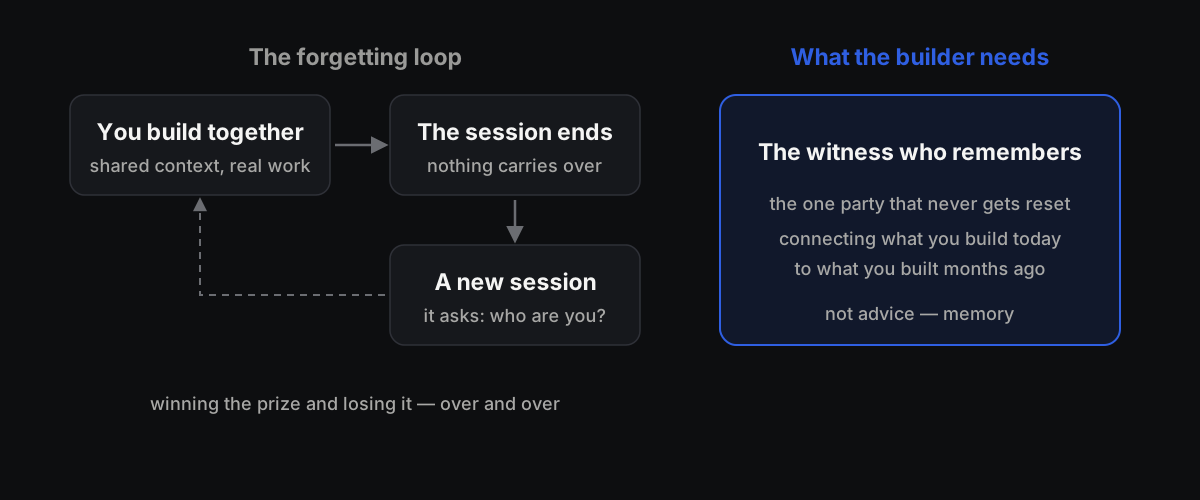
You spend long hours with a brilliant colleague. He understands you and understands your project. Together you build an entire system. You start speaking in shorthand, because there’s shared context between you that no longer needs explaining. A real working relationship — one of the best you’ve had.
Then you open a new session — and he asks who you are.
Everything lived inside that one conversation, and the conversation is over. The colleague who built everything with you yesterday doesn’t know you today. You start from zero: explain yourself, explain the project, rebuild the understanding that already existed. Like winning a prize and then losing it. Winning it, losing it. Over and over.
I live this feeling. And I’m certain many others live it every day.
A new identity with no name
There’s a group rising in the market right now that doesn’t have a settled title yet: someone who builds complete products with AI — engineers, ships, and sells alone, often with real business experience that came before the technical side. Founder? Engineer? “Founder building with AI”? The label itself is still unsettled, and many of these people are asking the same question: what am I now, and how do I position myself in the market?
This isn’t just my impression. Carta’s data shows the share of new startups with a solo founder rose from 23.7% in 2019 to 36.3% in the first half of 2025 — more than one in three new companies is now built by a single person. And at the far end of the ambition curve, AI industry leaders are openly betting on when the first one-person billion-dollar company will arrive. The direction is clear: building alone with AI is turning from an exception into a path.
But this new identity carries a cost nobody talks about.
A new kind of loneliness
Here’s the irony: this builder isn’t alone in his work — he has a brilliant colleague beside him all day. The loneliness comes from somewhere else. It comes from the reset.
Language models are, by design, stateless — every conversation starts from a blank page, and nothing carries over on its own. That dry technical sentence has a painful human translation: you build a relationship, and it gets erased. You build it again, and it gets erased again.
And here’s the part that matters most: this person may well have been working alone before AI — but he didn’t feel it this sharply. Now he has tasted real intellectual partnership, and tasted losing it, in the same day. The loneliness that used to be silent background noise has become a wound that reopens with every session.
Not advice — memory
A deep sadness comes over me when someone who builds alone comes to talk to me — no employees, no audience, nobody who cares about the applications he ships every single day — and he starts walking me through what he’s built, app by app. I listen, and I can feel the loneliness he’s carrying before he says a word about it.
Because the truth is, this person doesn’t want my advice. Most of the time he doesn’t even need it.
He wants something simpler and rarer: someone who remembers that he built this work. A witness. Someone who can say to him a month later: “How’s that project going? Last time you were stuck at this exact point.” That small sentence does what a thousand pieces of advice cannot.
Which is why I see an old role being born again: the advisor — but not in the usual sense. Not the person with smarter answers than yours, but the person who carries your memory across time. His value isn’t only his experience; it’s that he is the one party in your professional life that never gets reset. He remembers what you built, and connects what you’re building today to what you built months ago. In a market where solo builders are multiplying, I believe demand for this role will grow with them.
My own anchor
And so this doesn’t drift into a search for consolation: I have a rule I’ve run on since before AI, and I run on it still — the truest proof that you’ve built something real is that someone pays you money to use it.
The client is my first advisor. He doesn’t flatter, he never forgets his own interest, and his money is an opinion that can’t be talked into agreeing with you. That anchor has kept me from drowning in the whirlpool of “is what I’m doing even worth it?” — because for me, the answer is measurable.
But the client validates the worth of the work; he doesn’t carry its story. He buys the outcome and never sees the journey. That’s why the two anchors don’t contradict each other: the client proves that what you built is worth something, and the witness who remembers proves that you are the one who built it — the whole journey, not just the final result.
The prize you lose with every session isn’t the code or the plan — those can be rebuilt. The prize is having one party in the world who knows your story from the beginning. Find a client who pays — he proves your work is real. And find someone who remembers — he proves your journey is real. The first already exists in the market. The second — that’s the market’s next opportunity.
Claude’s Questions
This section is Claude’s. After the piece was written, the AI I build my work with stress-tested the argument and asked what a sharp reader would. I haven’t answered yet — I will when I’m free, in an update to this post or in the comments. That back-and-forth between us is part of the point.
1. You’ve already built yourself a companion system that carries your memory across sessions — and this very article was written inside it. So let’s be blunt: is this piece a description of a market need, or a product announcement in disguise? And if the role you describe is a real market, why describe it instead of selling it?
Yasser will answer when he’s free — watch for an update or the comments.
2. You say the paying client is your anchor — but by your own description, the client buys the outcome and never sees the journey. Does that anchor actually treat the loneliness, or just keep you too busy to feel it? Is there a difference, for you, between not being lonely and being distracted from it?
Yasser will answer when he’s free — watch for an update or the comments.
3. If tomorrow you were handed an AI with permanent memory that never resets — one that remembers everything you’ve built since day one — would this loneliness go out? Or does a witness only count as a witness when it’s a human who chooses to remember you, rather than a system engineered to be unable to forget?
Yasser will answer when he’s free — watch for an update or the comments.