A note before you read: this piece began as my own voice notes and raw ideas — Claude wrote them up, edited them, fact-checked the numbers, and added the sources. The core opinion is mine; the wording is a partnership between us. I’d rather ship the idea alive than wait until it’s perfect. — And that note, the one you’ve seen at the top of every post here? This article is its story.
You might be wondering as you read this blog: Yasser, you say you record voice notes every day, and that behind them sits a system you built with AI that turns them into finished articles and publishes them. How? What’s the idea? And why?
Let me give you the ending first: the idea never arrived. I never sat down one afternoon, thought it up, and went and built it. This system is the harvest of years — not years of expertise, years of small observations.
A pile of notes I didn’t know what to do with
The story started with scattered observations, each stacking on the last:
While working on some app, I noticed I wanted a place to capture my thoughts — I’ve never liked pen and paper. Then a second observation: I should really be recording the meetings I run. Then a third: I want to be able to come back and reread all of this, anytime. And so it built up, little by little, until I had a huge archive of notes… and no idea what to do with it. Just information, accumulating.
Then I started asking: how could AI actually help me here?
The attempts that failed
The first experiment half-worked: I told the model, learn from these notes and discuss them with me. It did — and I found myself going back and rereading them. Nice. But it wasn’t a system.
Then came the big idea: why doesn’t the AI write articles from these notes?
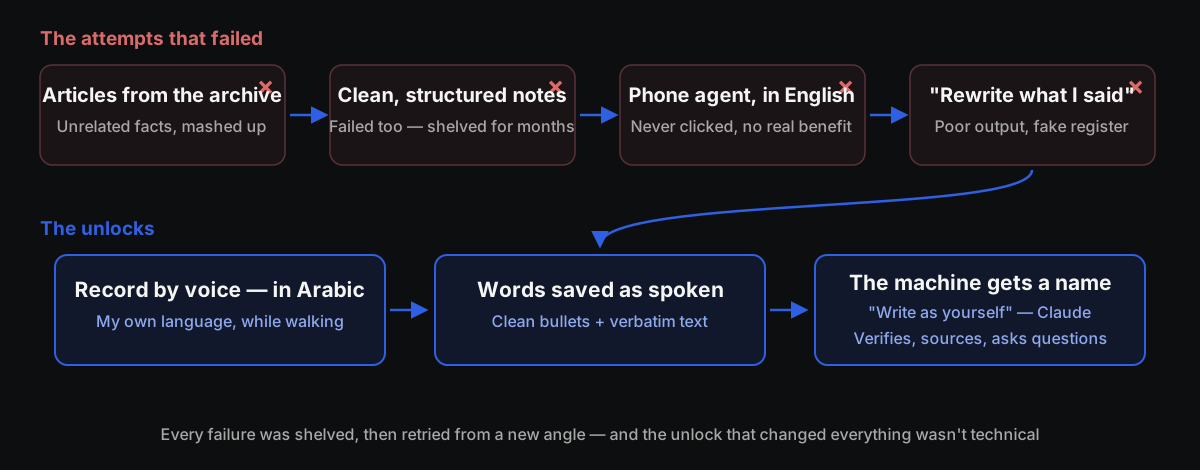
- Attempt one: write articles from the archive. Result: it grabbed two unrelated pieces of information and mashed them into a mess. Failed. I dropped the whole thing — I was busy with something else anyway.
- Attempt two, some time later: fine, I’ll hand you the notes myself, clean and structured — you write from those. I fed it note after note. Failed again. Dropped it again.
- Attempt three, in a later phase: I built an agent I could talk to on the phone — it was a hype wave at the time, so I figured I’d try. I talked to it… in English. It never clicked; no real benefit. Failed.
Notice the pattern: every attempt fails, I walk away, I come back months later from a new angle. That wasn’t strategy — it was being busy. But it turns out the walking away was part of the recipe: meta-analytic research on incubation finds that stepping away from a problem and returning to it genuinely improves how you solve it (Sio & Ormerod, 2009).
The unlocks
Some time after the failed phone experiment, a simple question hit me: why am I speaking to it in English at all? Why not Arabic? I dug around and found that OpenAI’s speech-to-text models support most of the world’s languages. I tried it — and it heard and understood Arabic. From that moment I was recording my notes by voice, in my own language, while walking or working.
Then the small unlocks came one after another:
- Why not have each note written up as clean bullet points, saved in one specific place? Built.
- Why not also save my words word-for-word, exactly as I spoke them? Every word I say, captured as said. Built.
- Back to the article idea: “read what I said and rewrite it another way.” Failed — the output was poor. Then: “don’t change the words much. Keep them almost as they are, just arranged — editing only.” The result was somewhat satisfying. But still not what I wanted.
The unlock that changed everything wasn’t technical
The output kept writing as if it were excited on my behalf — a fake register. So I said something strange to the model: “doesn’t it suffocate you, writing while pretending to be me? Write as yourself, under your own name.” And I gave it its name: Claude. Write as if you, Claude, are editing for me.
It answered: alright — but some of what you said contains claims I’d need to verify.
I said: verify everything. Add the links. Add every source.
The first article still wasn’t great. So I added the last directive: arrange my ideas in light of everything you’ve read — I might mention a point at the start that connects to one at the end; pull them into a single thread, kept simple, but one core idea.
Then one final addition occurred to me: what if we answered the questions a deep reader would actually think of? Claude liked the idea. I said: and let the questions stay open — I’ll answer them later, or readers will. From that conversation, the “Claude’s Questions” section that closes every post here was born — including the one at the end of this very article.
The first article came out. I let it sit for two days, reading and re-reading it: would this actually be useful to anyone? It held up. And we started publishing.
The lesson isn’t that it’s easy — or hard
Some people might read this story and assume it’s easy, that anyone could build it in a day. The lesson here isn’t easy versus hard. The lesson: the idea that arrives today doesn’t have to be executed tomorrow, or next week — you don’t even have to know what it’s for yet. It can take years. That’s completely normal. Let it ripen on a low flame.
And I’ll confess something: I am impatient by nature. Badly impatient — I want everything finished today. So I’m in a permanent fight with myself: don’t raise the ceiling of expectations. You won’t finish everything today, and tomorrow you’ll say “there’s still so much left” — and that’s perfectly normal.
But consider this: if you do one thing every day — your target is one thing only, one article, one note — then in a year you’ve done 365 things. And by my own estimate, that alone puts you ahead of most people who are still sitting there waiting for the perfect moment, doing nothing. You’ll watch it happen: something small today, something bigger tomorrow. That’s how the snowball grows — it starts as a pebble of ice, and then nothing stops it.
This entire blog is a snowball that started with one observation: “I want a place to capture my thoughts.”
Claude’s Questions
This section is prepared by Claude. After the article was written, the AI engine I build my work with stress-tested the argument and asked what a sharp reader would ask. I haven’t answered yet — I will when I’m free, in an update to the article or in the comments. This conversation between us is part of the idea itself.
1. At what point does this stop being “your” writing? The idea is Yasser’s; the wording is the machine’s. Where is the line beyond which the byline should change? And does the reader deserve to know more than the disclaimer tells them?
Yasser will answer when he’s free — watch for an update or the comments.
2. I have years of scattered notes and no system — what do I do in the first week? This story took years and a pile of failed attempts. What first step would cut half of that road for a reader today, with tools already in their hands?
Yasser will answer when he’s free — watch for an update or the comments.
3. What’s the strongest case against publishing unread? One wrong idea shipped under your name can cost credibility built over dozens of articles. Why is speed worth that risk — and where is the safety line past which an article must be read before it goes out?
Yasser will answer when he’s free — watch for an update or the comments.
4. Every attempt failed until the machine became a named partner instead of a commanded tool — what does that say about how we’ll all work with AI? Was giving it a name a psychological trick on Yasser himself, or a real change in the machine’s behavior? And which of the two matters more?
Yasser will answer when he’s free — watch for an update or the comments.