

A note before you read: this piece began as my own voice notes and raw ideas — Claude wrote them up, edited them, fact-checked the numbers, and added the sources. The core opinion is mine; the wording is a partnership between us. I’d rather ship the idea alive than wait until it’s perfect.
I was watching a TV show when one character said a line that made me pause the episode: humiliate one person in front of everyone, and the team’s perceived value goes up. Push one individual down, and the rest feel the group got stronger.
A line from a TV show. But it wouldn’t let me go. So I researched it.
What the studies actually say
It turns out the phenomenon has a name in social psychology: the Black Sheep Effect. In 1988, Marques, Yzerbyt and Leyens demonstrated something surprising: a group judges its own deviant member far more harshly than it judges an outsider doing the exact same thing. The “unlikeable” Belgian student got worse ratings from fellow Belgians than an unlikeable foreigner did. (the original study)
Here I owe the TV line a small correction: the research doesn’t say humiliating one member directly “raises” the team’s value. It says something more precise — and more dangerous. Attacking the deviant protects the group’s image of itself. The deviant threatens the group’s identity from within, so degrading or expelling him restores the members’ feeling that their group is pure and its norms are right. The punishment isn’t about the act. The punishment is fuel for cohesion.
The philosopher René Girard named the oldest face of this mechanism the scapegoat: when a community fractures from within, it suddenly unites against a single victim — and by expelling that victim, peace returns. (Girard) Group unity, purchased at the price of one person.
The second blade: cutting down the outperformer
The Black Sheep Effect punishes the deviant. But there’s a sibling phenomenon that punishes the outperformer: Tall Poppy Syndrome — the flower that grows above the field gets cut so the field stays level. In a study of over 4,500 people across 103 countries, 86.8% said they’d experienced it at work: attacked, diminished, or boxed in because of their achievement, not despite it. (the study)
Two separate phenomena in the literature. Now watch what happens when they meet in one person.
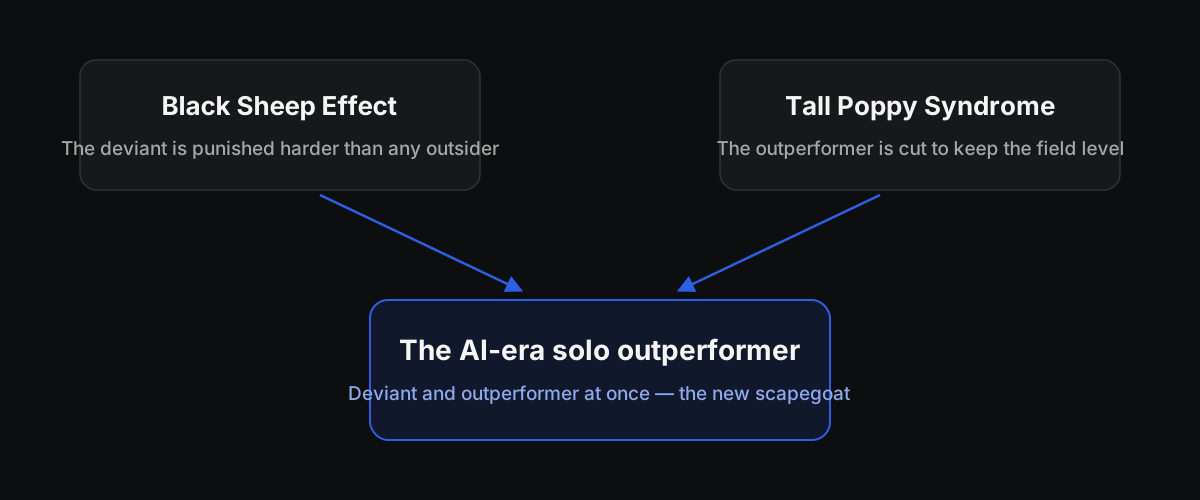
The solo outperformer: a black sheep twice over
Here’s my core idea — my own reading of what I’m watching in the market:
With AI, solo work can now produce what used to take a full team — sometimes better. One individual armed with these tools threatens the group’s equation twice at once:
- He’s a deviant: works alone, works differently, outside the team’s rituals — so he earns the black sheep’s punishment.
- And he’s an outperformer: his output exposes the group’s average — so he earns the tall poppy’s shears.
Deviant and outperformer, simultaneously. A group that feels its value dropping next to him won’t re-examine its methods. It will do what groups have done since forever: make him the scapegoat. Embarrass him, shrink his wins, turn him into a cautionary tale — because taking him down is psychologically cheaper than admitting the old model is over.
And this isn’t a prediction for me — it’s what I’m seeing in the market right now. The black sheep are walking out of their organizations, one after another. Some get pushed. Most leave on their own and build solo.
We have an answer older than the studies
What I find striking is that my own tradition settled this mechanism centuries ago — from both ends.
First end — group fanaticism: Islam condemned asabiyyah: backing your group in the wrong simply because it’s your group. When two factions of his own companions started lining up against each other, the Prophet ﷺ shut it down with one word — “leave it, it is rotten.” (reference) Raising a group’s value by crushing one of its members is exactly that rot: loyalty to the image, not to the truth.
Second end — public humiliation: correction itself is legitimate, but it comes with an etiquette that flips the whole equation. The lines attributed to Imam al-Shafi’i put it plainly: whoever counsels his brother in private has advised him and honored him; whoever counsels him in public has exposed him and shamed him. Private advice is repair; advice in front of the crowd is exposure. Which means the tool from the TV show — shaming someone in front of colleagues — is rejected at the root even when the person is genuinely wrong. What then, when his only sin is producing more than everyone else?
The group’s interest is never built on the back of an individual sacrificed for it in public. That’s my tradition’s position — and, strikingly, it’s where the research landed centuries later: a group that needs a scapegoat to hold together was never held together in the first place.
The takeaway
Groups will keep protecting their self-image, and AI will keep producing individuals who outgrow them. If you lead an organization: your black sheep isn’t a threat to your team — he’s an early sample of its future. And if you are the black sheep: what’s happening to you isn’t an anomaly and isn’t personal. It’s a documented mechanism older than every institution on earth. Know its name, refuse to take it personally — and decide calmly: do you fix the field from inside, or plant your own?
Claude’s Questions
This section is prepared by Claude. After the article was written, the AI engine I build my work with stress-tested the argument and asked what a sharp reader would ask. I haven’t answered yet — I will when I’m free, in an update to the article or in the comments. This conversation between us is part of the idea itself.
1. When does the idea turn on itself? If AI makes solo outperformance available to everyone, the “deviant” becomes the majority — does the Black Sheep Effect dissolve at that point, or do groups simply redefine themselves to manufacture new black sheep to cohere around?
Yasser will answer when he’s free — watch for an update or the comments.
2. The strongest counter-argument: a group’s harshness toward its deviants isn’t always pathology — sometimes it’s precisely what makes a team able to coordinate at all. Couldn’t the organization that “cuts down” the solo outperformer be protecting something real: shared knowledge, continuity, and not having its fate hostage to one person? Where’s the line between scapegoating and legitimate discipline?
Yasser will answer when he’s free — watch for an update or the comments.
3. The practitioner’s question: I’m the solo outperformer inside a traditional organization, and I can feel the shears getting closer. Monday morning — what’s the right play? Hide my output to survive, show it and pay the price, or leave early before I get cut?
Yasser will answer when he’s free — watch for an update or the comments.