

A note before you read: this piece began as my own voice notes and raw ideas — Claude wrote them up, edited them, fact-checked the numbers, and added the sources. The core opinion is mine; the wording is a partnership between us. I’d rather ship the idea alive than wait until it’s perfect.
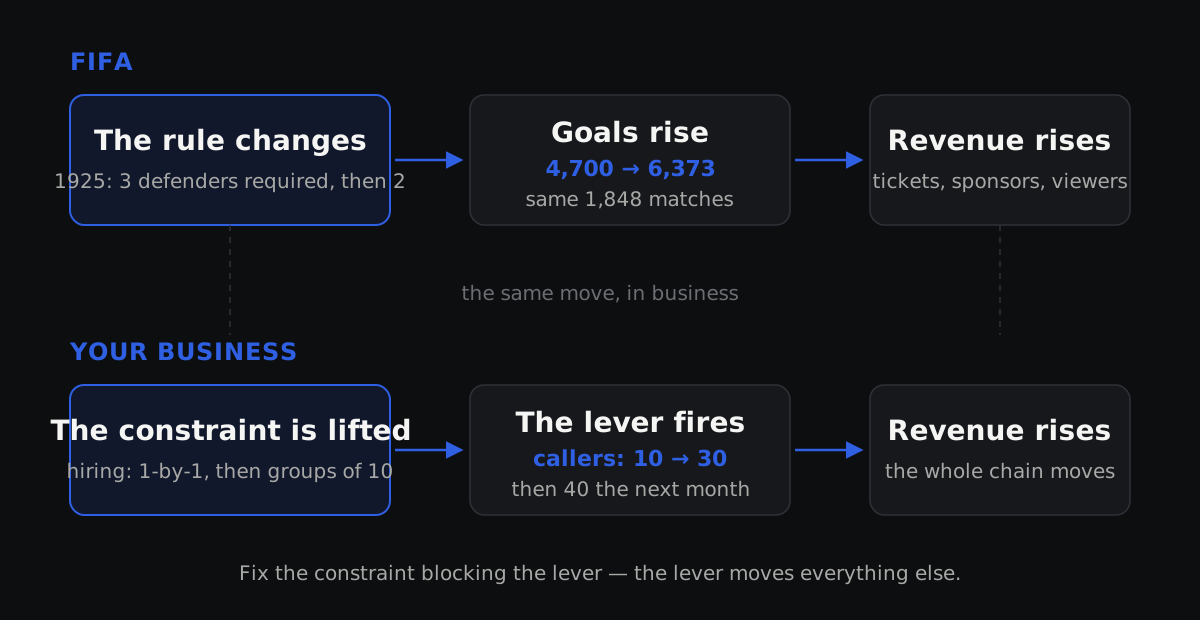
In the 1925/26 season, something strange happened in English football: goals jumped from 4,700 to 6,373 across the same number of matches — 1,848 of them. A near 36% spike in a single season.
The players didn’t get better overnight. What changed was one rule: offside. The number of defenders required was dropped from three to two. The goal opened up, and goals poured in.
That wasn’t an accident. It was design.
A rule that looks like fairness is really about money
We assume football’s laws change to protect the player, or to be fair to the team, or because they’re “more just.” Look at what actually moves them.
FIFA is an institution. Its objective is revenue. And revenue in football comes from tickets, ads, sponsors, viewership. All of those feed on one thing: excitement. And excitement, in the language of the pitch, is spelled goals.
So when FIFA sits down and asks, “How do we grow revenue?”, the real question underneath is, “How do we grow goals?” And since you can’t order the keeper to lie flat on the ground, and you can’t dismantle the defense, you look for a lighter lever: one small rule you can tune so that everything shifts — without the player ever feeling weakened.
The offside rule is that lever.
And it’s been proven at least twice: the 1925 change, then the 1990 amendment that made a player level with the second-last defender onside. The stated reason was explicit: “to encourage the attacking team” and “give the attacking player an advantage over the defender.” They didn’t say “for revenue.” They said “for attacking play.” And attacking play is goals, and goals are money.
The new proposal shows you the whole game
Today, Arsène Wenger — as FIFA’s Chief of Global Football Development — is pushing to change the rule again: keep an attacker onside as long as any part of their body that can legally score is level with the second-last defender, instead of requiring their entire body to be behind the defender.
Put plainly: instead of a shoulder ahead of the defender being enough to flag you offside, you’d stay onside as long as some part of you is level. FIFA hasn’t approved it yet, but it’s already in trial — the Canadian Premier League is testing it in the 2026 season.
The rule is still being tuned. And the direction hasn’t changed in a century: more goals, more excitement, more money.
Every business has its own offside rule
Here’s the lesson I care about.
Football is a complex system: two-man moves, wingers, tactics, fitness. Dozens of variables. But FIFA doesn’t fiddle with all of them. It found one variable that governs the outcome it wants — goals — and it aims every intervention at that one thing.
That isn’t just football smarts. It’s one of the deepest principles in business, and someone already wrote a whole book about it.
In 1984, Eliyahu Goldratt published a business novel called The Goal, laying out what came to be known as the Theory of Constraints. The whole thing fits in one sentence:
“Every system has a single constraint that governs its entire throughput. Improving anything else doesn’t move the result — only the constraint moves it.”
The slowest link in a chain sets the speed of the whole chain. Add capacity to any other link and nothing changes. The constraint alone governs.
Every business — however complex it looks — has a constraint like that. One lever that, when it moves, moves all the revenue. The craft is to find it, then remove what’s blocking it.
An example I lived: when “offside” was hiring speed
At one company, we asked the same question: what’s the highest-leverage variable for revenue?
The answer was direct calls — cold calling. Dial, pitch, close. And the numbers were clean: a given number of callers mapped to a known amount of revenue. Want to double revenue? Then double the callers.
So we asked: how many callers do we have? Ten. Why not thirty?
Here’s where the real offside rule showed up: the bottleneck wasn’t the number of callers — it was hiring speed. We were hiring one at a time — a one-on-one interview per candidate — and couldn’t keep up. The lever was calls, but the constraint choking it was hiring.
So we removed the constraint: instead of interviewing one candidate per session, we ran a group onboarding of ten at once, and hired four from each session. The pace compounded: ten became twenty, then thirty, then forty the following month.
Notice the sequence. We didn’t chase the lever directly. We chased what was blocking the lever. FIFA doesn’t order more goals — it tunes the rule that prevents them. And we didn’t order more calls — we fixed the hiring that was choking them.
One difference worth being honest about
FIFA can change its rule because it owns the game. Most of us don’t own our market’s rules, or our platform’s.
So the lesson isn’t “change the rule.” It’s sharper than that:
Find the one variable that governs your revenue, then remove the constraint choking it.
Sometimes the constraint is a rule you actually own (like FIFA). More often it’s an internal bottleneck — slow hiring, a manual step, a delayed approval. Either way, the rule holds: don’t scatter your energy across ten variables. Find the one that governs, and put all your weight behind it.
Claude’s Questions
This section is Claude’s. After the piece was written, the AI I build my work with stress-tested the argument and asked what a sharp reader would. I haven’t answered yet — I will when I’m free, in an update to this post or in the comments. That back-and-forth between us is part of the point.
1. FIFA raised revenue by adding goals — but a goal is valuable because it’s rare. If the rule change works too well, doesn’t it cheapen the very thing people pay to watch? Where’s the line where pushing your revenue lever starts destroying it?
Yasser will answer when he’s free — watch for an update or the comments.
2. FIFA can change its rule because it owns the game; most businesses can’t change their market or platform rules. So is your point “change the rule,” or “remove the constraint blocking your lever”?
Yasser will answer when he’s free — watch for an update or the comments.
3. Your cold-call example found the lever by accident — is there a method to find yours, or is it luck?
Yasser will answer when he’s free — watch for an update or the comments.