

A note before you read: this piece began as my own voice notes and raw ideas — Claude wrote them up, edited them, fact-checked the numbers, and added the sources. The core opinion is mine; the wording is a partnership between us. I’d rather ship the idea alive than wait until it’s perfect.
When I started working for myself, my math was simple: at a job I could work 8 hours, 9 hours, sometimes 12. So why not put those same hours into my own business? Twelve hours a day on my own thing and I’d be unstoppable. I quit the job and ran the plan.
I couldn’t do it. No matter how hard I tried, no matter how much I forced myself, the most I could squeeze out was 3 hours a day. After that: headache, exhaustion, drowsiness, and a fog so thick I’d open something to read and couldn’t hold focus for a single line. Sometimes the fatigue stacked up until I’d drop the work for a full week and produce nothing.
It took me a long time to understand the sentence I now say to anyone who’s gone deep into working for themselves and started turning sour on it: when you work for yourself, your boss is crazy.
You’ll ask: how? I work for myself — there’s no boss above me. Exactly. Your new boss is your brain. And it’s a crazy boss with three symptoms: it fights you, it moves the finish line, and it forgets.
Symptom one: a boss who fights his own employee
Why only 3 hours? The main reason: fear.
The human body carries an ancient survival mechanism — wiring our Creator placed in us: when the brain senses danger or the unknown, it treats it as a threat. And self-employment is all unknown — no guaranteed salary, no clear path, nobody who’s walked it in your exact circumstances. So your brain speaks to you in the only language it has — headache, fatigue, sleepiness: stop. This thing is draining. This thing is dangerous. Don’t do it. That link between uncertainty and the threat response is well documented in neuroscience (Grupe & Nitschke, 2013). Your brain is against you — not because you’re weak, but because it thinks it’s protecting you.
I used to hear constantly that humans have a fixed focus limit — 45 minutes for a lecture, and after that nothing goes in. I looked it up, and the number turns out to be closer to folklore: Wilson and Korn’s review found no evidence for a fixed human attention limit (Wilson & Korn, 2007). The truth is more precise and more useful: attention for hard, uncertain work is bounded, and it varies from person to person. The universal number doesn’t matter. Your number is the one that matters.
And here is the only cure I’ve found for the fighting boss: repetition. Every time you do the thing once, twice, three times, your brain learns: we’ve done this before and nothing happened — no danger here. For me, the 3 hours became 4, then kept climbing. The protocol I recommend from my own experience:
- Work until the real fatigue arrives — the drowsiness, the fog — and note the time.
- That number is your official working time for one month. Don’t exceed it, and don’t beat yourself up over it.
- After a month you’ll notice you can push it. Add thirty minutes — no more.
Everything in life is physical, measurable — and what you can measure, you can build on. Years ago I recorded a YouTube video about this phenomenon without knowing its cause — all I could say back then was “keep going, this happens to everyone.” Now I know the why and the how, and this article is the answer that video was missing.
Symptom two: a boss who moves the finish line
I used to assume the business had an ending — a light at the end of the tunnel that you reach and finally rest. The light is real. But you never reach it.
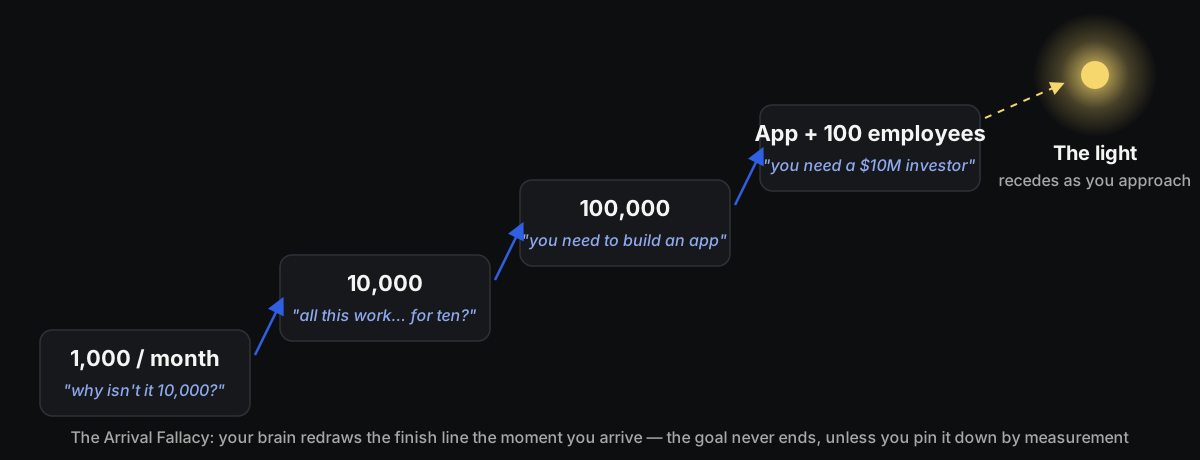
Why? Because your ambition rises with every step. You’ve reached the light dozens of times, and every time you tell yourself: no, this isn’t it. You dreamed of 1,000 riyals a month; the thousand arrived and you didn’t feel arrival — you asked why it wasn’t ten thousand. The ten thousand arrived and you said: impossible — all this work for just ten? It should be a hundred thousand; something must be wrong. Then before you know it, your boss has convinced you the new light requires an app you must build, then a hundred employees you must hire, then an investor with ten million. The light never ends.
This feeling has a documented name: the Arrival Fallacy — the term belongs to Tal Ben-Shahar, the Harvard positive-psychology lecturer: the illusion that reaching the goal will deliver lasting satisfaction, while your brain resets the ceiling the moment you arrive (The New York Times). It’s a close cousin of what researchers call the hedonic treadmill: you run and run, and satisfaction snaps back to baseline.
The fix isn’t to chase the light — it’s to know your boss is the one moving it. Calibrate to your capacity, not to the light: set the number before you reach it, write it down, and when you arrive, celebrate it in writing — before the crazy boss convinces you it was never a goal at all.
Symptom three: a boss who forgets
Think of the worst boss you’ve ever worked for. I’d bet your first complaint is: he forgets. He didn’t remember your effort. He didn’t remember what you two agreed that day. He didn’t remember his promise. The first and biggest problem between an employee and a manager is forgetting — because a boss who forgets your achievements changes his mind every few weeks, his evaluation of you swings for no reason, and his relationship even with himself isn’t healthy.
In your own business, you are the boss — and you’re the one who forgets. You forget how much you shipped last month, so you flog yourself. You forget the decision you made with full conviction, so you reopen it from zero. You forget you ever reached the light. We all forget — but some of us forget more than others, and that difference has a physical basis and a physical fix: healthy sleep, healthy food, exercise. Sleep in particular is when the brain consolidates its memory — one of the most established findings in memory research (Rasch & Born, 2013). Your health isn’t a side quest in your business; it’s the single biggest input to your results — because it’s memory maintenance for the manager you work under. The less the forgetting, the less the madness.
The takeaway
Quitting the job doesn’t mean you escaped the crazy boss — it means you transferred to the craziest one of all: your own brain. It fights you because it fears for you — tame it with repetition. It moves the light because it’s ambitious — pin the goals down with measurement. It forgets because it’s flesh — maintain it with sleep, food, and movement. Your boss will stay crazy. But a crazy boss whose symptoms you know and measure is one you can work with. One you can even build something great with.
And if you ever say it to someone — “your boss is crazy” — explain it this way, so nobody takes it personally.
Claude’s Questions
This section is prepared by Claude. After the article was written, the AI engine I build my work with stress-tested the argument and asked what a sharp reader would ask. I haven’t answered yet — I will when I’m free, in an update to the article or in the comments. This conversation between us is part of the idea itself.
1. When does repetition stop working? The article says habituation gradually raises your ceiling. But plenty of founders burn out after years, not weeks. Is there a hard limit to endurance no matter how trained you are? And when does “add thirty minutes a month” become a recipe for slow burnout instead of taming?
Yasser will answer when he’s free — watch for an update or the comments.
2. What if the crazy boss is right? The strongest case against this piece: the fatigue at hour three might not be fear of the unknown — it might be an honest signal that this particular work isn’t yours. How do you tell resistance that needs taming from an alarm that needs hearing?
Yasser will answer when he’s free — watch for an update or the comments.
3. I’m an employee thinking about quitting — what should I measure before I jump? This article was written from the far bank, after the leap. What numbers, had Yasser known them before resigning, would have changed how he ran his first year?
Yasser will answer when he’s free — watch for an update or the comments.
4. If you fully tame the boss… who’s left to dream? The receding light is the same force that pulled you out of the job. If you pin every goal down with measurement and kill the illusion — does the spark die with it? Is the moving light a bug in the brain, or its engine?
Yasser will answer when he’s free — watch for an update or the comments.