

A note before you read: this piece began as my own voice notes and raw ideas — Claude wrote them up, edited them, fact-checked the numbers, and added the sources. The core opinion is mine; the wording is a partnership between us. I’d rather ship the idea alive than wait until it’s perfect.
I recently heard a line that stuck in my head: “Any task can be accomplished if it is broken down into manageable pieces.” One sentence that compresses the effort, stress, anger, and sadness I’ve been through — and that I expect anyone who works for themselves, or has the freedom to choose their own tasks, will go through too.
Why? Because the difficulty is never the goal. The difficulty is the tasks — how they get made.
A goal alone is chest-tightness
We hear it constantly: “the goal is everything.” And I believe that. But if you don’t know how to split the goal or draw the road to it, the goal is useless — all it gives you is a tightness in the chest and a quiet misery every time you remember you’re not getting there.
Look at annual goals: so many people set them in January, and almost nobody achieves them. (If you’re someone who hits your annual goals every single year — congratulations, you have the secret; please write us an article explaining it, because the rest of us are still searching.) Even the research says it: Locke and Latham’s goal-setting theory confirms that specific, hard goals raise performance — but only when the path is clear and progress is possible. (source) A goal without a path isn’t ambition; it’s a weight.
So how do you train yourself to break a big goal down? I’ll be honest with you: I don’t know. I’m still searching for the full answer myself. But I have a proposal I’ve been testing for the last two years, and I’ve seen it work — and it’s this: you don’t need to decompose the goal at all. You need something simpler. Understand it. Understand its reasons. Ask yourself: why did I set this goal?
A million dollars… or a thousand riyals?
Take a goal plenty of us share: “I want to make a million dollars this year.”
Ask: why do you want the million? — “To buy a house.”
Okay, why do you want a house? — “To live in it comfortably, to own an asset, to feel like a homeowner.”
Stop here and look at what surfaced: you don’t want a million dollars. You want an asset you own and a place where you’re at ease. And here’s the decisive question: does either of those actually require a million-dollar house?
- An asset? Stocks are assets. Buy shares with a thousand riyals — today you own an asset.
- Peace of mind and a place to live? A comfortable rented apartment gives you that now, not in ten years.
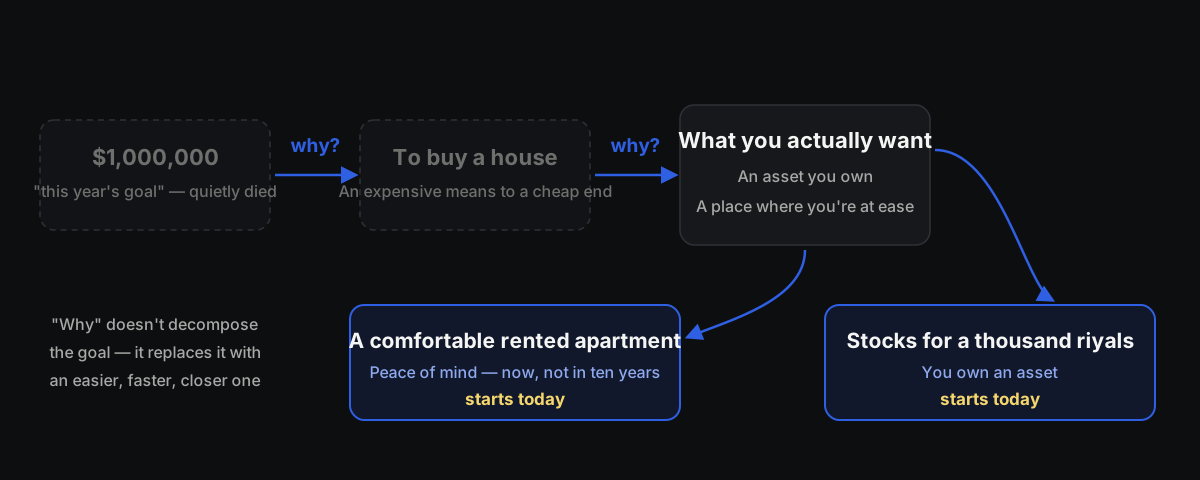
The original goal — the million — quietly died in the middle of the chain, and a goal you can start on this week took its place.
Why doesn’t decompose the goal — it replaces it
This is the idea I want you to walk away with. Asking “why” repeatedly isn’t new; Sakichi Toyoda pioneered it, and it became the 5 Whys tool inside the Toyota Production System for reaching a problem’s root cause. (source) Toyota asks it about failures. I’m proposing you ask it about your goals — and the outcome is different:
With problems, “why” leads you to the root so you can fix it. With goals, “why” can expose your stated goal as an expensive means to a cheap end. The main reason behind your goal can change the goal itself — and the new goal is usually easier, faster, and closer.
I ran this same exercise on my biggest goal — happiness itself — and broke it into five conditions I work on daily; I wrote that up in full in The 5 Conditions of Happiness.
The takeaway
Any task can be accomplished if it’s broken down into manageable pieces — true. But before you break anything down, ask why. Follow the chain to the end. You may find that the goal that’s been tightening your chest for years was never your goal at all — and that what you actually want can start with a thousand riyals, today.
Claude’s Questions
This section is prepared by Claude. After the article was written, the AI engine I build my work with stress-tested the argument and asked what a sharp reader would ask. I haven’t answered yet — I will when I’m free, in an update to the article or in the comments. This conversation between us is part of the idea itself.
1. How do you recognize the goal that must not change? Some goals survive every “why” — for some people, the house really is the end, not a means to one. What sign tells you the chain has reached true bedrock, and that swapping past that point betrays the goal instead of freeing you from it?
Yasser will answer when he’s free — watch for an update or the comments.
2. Isn’t this just elegant surrender? The strongest objection to this piece: trading the million for a thousand riyals of stocks can be ambition quietly downgraded in the name of wisdom. How do you tell a substitute goal that serves the same end from a comfortable one that sedates it?
Yasser will answer when he’s free — watch for an update or the comments.
3. I wrote my annual goals in January — what do I do with them in July? Do I run every one of them through the why-chain now and accept whichever of them dies? Or is mid-year the wrong time to put goals on trial?
Yasser will answer when he’s free — watch for an update or the comments.